

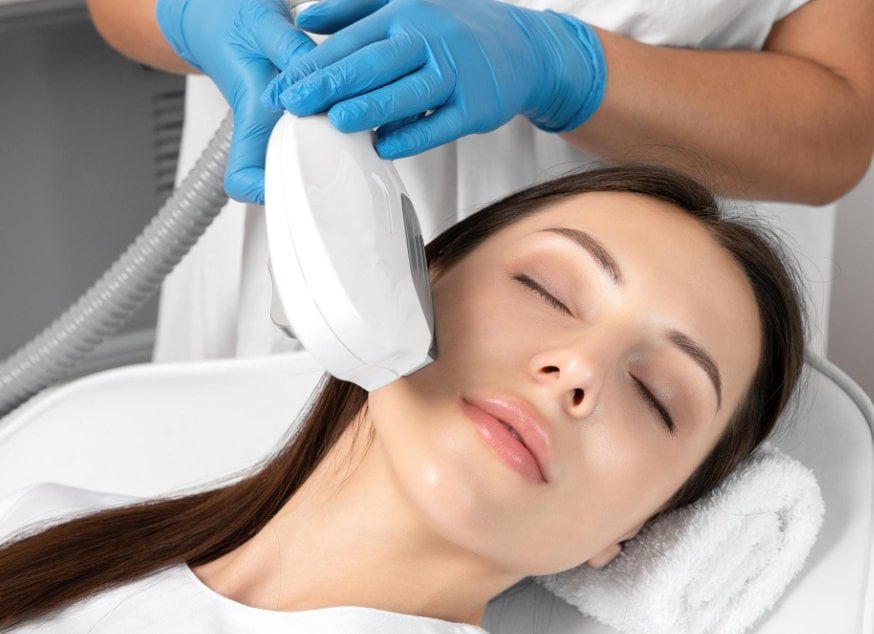
Somewhere between a chemical peel and a full ablative laser sits a category of treatment most people have heard of by name, "Halo", without quite knowing where it actually fits on the spectrum. Is it a stronger peel? A gentler laser? Both, sort of? The honest answer is that Halo is a hybrid fractional laser, combining two different wavelengths of laser energy in a single treatment to address both surface texture and deeper skin quality at once, a genuinely different category from either a standalone peel or a traditional single-wavelength laser, offered at Ayala Plastic Surgery's medical spa under the direction of board-certified plastic surgeon Dr. John Ayala, MD.

Start With the Spectrum, Not the Brand Name
Before getting into what makes Halo specific, it helps to place the three broad categories on one continuum, from gentlest to most intensive.
Chemical peels use acid solutions to remove the outermost layer of skin, ranging from very light, no-downtime options to deeper peels with more significant recovery. They're a well-established, effective category, particularly for surface-level tone and texture concerns, but they work on the skin's surface primarily, with less ability to reach deeper structural layers.
Traditional ablative or non-ablative lasers, covered in more depth on our laser skin resurfacing page, use a single wavelength of light energy, either removing the surface layer directly (ablative) or heating tissue beneath an intact surface (non-ablative). Each single-wavelength approach has real strengths, but also real limits tied to that one wavelength's specific depth and mechanism.
Hybrid fractional lasers like Halo combine two wavelengths, one working at a more superficial level, similar in spirit to a peel's surface renewal, and one working deeper, similar to a non-ablative laser's collagen-stimulating mechanism, delivered together in a single session. The idea is addressing both layers of concern at once, rather than choosing one depth and leaving the other untouched.
So Which One Is Actually Right for You?
This is less about which technology is "best" in the abstract and more about matching the tool to your specific combination of concerns and tolerance for downtime.
If your primary concern is surface tone and texture (mild discoloration, a dull complexion, early fine lines) with minimal downtime tolerance, a lighter chemical peel may be the most efficient, lowest-commitment option.
If your concern is more specifically about deeper collagen stimulation with no surface wounding at all, a non-ablative laser alone may fit better, particularly for patients who want zero visible downtime.
If you're dealing with a combination (texture and tone concerns on the surface, alongside a desire for deeper collagen stimulation) and you're willing to accept a middle amount of downtime in exchange for addressing both in one session, that's the specific gap Halo is built to fill.
None of these are permanently locked choices. Many patients use different tools at different points, starting with peels for maintenance and moving to something like Halo when they want a more comprehensive reset.
What a Halo Session Actually Involves
Treatment begins with topical numbing to manage comfort, followed by the laser delivering both wavelengths across the treatment area in a single pass. Most sessions take well under an hour. Immediately afterward, skin typically appears flushed, similar to a moderate sunburn, with a bronzing or darkening effect developing over the following one to two days as the treated superficial layer prepares to shed.
Recovery: More Than a Peel, Less Than Full Ablative Resurfacing
This is exactly where Halo's "in between" positioning shows up most concretely in daily life. Expect visible bronzing and light peeling or flaking for roughly three to five days, generally manageable with gentle skincare and diligent sun avoidance rather than requiring time fully away from normal activities, though many patients prefer to schedule around a few quieter days regardless. This is meaningfully less downtime than a deep chemical peel or full ablative laser typically requires, while still delivering more visible surface renewal than a purely non-ablative treatment with zero downtime.
How Many Sessions, and How Often
Unlike a single, one-and-done full ablative laser treatment, Halo is often used as a periodic treatment, commonly once or twice a year for maintenance, or in a short initial series for patients addressing more significant concerns before shifting to a maintenance schedule. This positions it well for patients who want a meaningful annual "reset" without committing to the more significant single-session downtime of a full ablative resurfacing procedure.
Why Combining Two Wavelengths Actually Matters, Mechanically
It's worth understanding the actual logic behind the hybrid approach, rather than taking "two wavelengths is better" on faith. The ablative component works at a superficial depth, removing a controlled, fractional pattern of surface cells to trigger fresh skin renewal, this is the part responsible for the visible bronzing and light peeling during recovery. The non-ablative component works simultaneously at a deeper level, heating tissue without disrupting the surface, triggering the same collagen-remodeling response used in standalone non-ablative treatments. Delivering both in one pass means the treatment addresses what's visible on the surface and what's happening structurally beneath it in a single session, rather than requiring two separate appointments with two separate recovery periods to achieve a comparable combined effect.
How Halo Compares to Microneedling
Halo and microneedling (including radiofrequency microneedling) both fall into the broader category of skin-renewal treatments, but they work through different mechanisms entirely. Microneedling creates controlled micro-injuries using fine needles, triggering the skin's wound-healing response and collagen production without heat or light energy at all, some versions add radiofrequency energy for a deeper effect, similar in spirit to what Halo's non-ablative wavelength achieves, but through mechanical rather than light-based means. Recovery from microneedling is generally milder than Halo's bronzing and peeling, making it a reasonable alternative for patients wanting a gentler option, though it doesn't address surface tone and pigmentation as directly as Halo's ablative component does. Which is right for you often comes down to whether surface tone correction or minimal downtime is your higher priority.
Who Should Think Twice
Because Halo combines two wavelengths, it carries the pigmentation-risk considerations relevant to laser treatment generally, particularly for darker skin tones, where wavelength selection and settings need to be calibrated carefully by an experienced provider. Active acne, certain skin conditions, and recent significant sun exposure or tanning are also reasons to pause and discuss timing with your provider before scheduling. None of these are permanent disqualifiers, they're simply reasons a thorough consultation, rather than a walk-in appointment, is the right starting point.
The Specific Concerns Halo Tends to Address Well
Patients considering Halo are typically dealing with some combination of: uneven skin tone or mild discoloration, enlarged pores, fine lines and early textural roughness, and a general sense that skin looks "tired" or dull rather than any single, isolated concern. It's less suited to deep, established wrinkles or significant scarring, where a more intensive ablative approach or a different modality entirely tends to produce a more meaningful result, one of the honest limits of a treatment built around moderate downtime rather than maximum intervention.
What One Session Realistically Achieves vs. a Series
A single Halo session produces visible improvement in tone and texture, generally apparent within a couple of weeks as the treated skin fully renews. But like most resurfacing technology working through a gradual biological process, cumulative results from a short series, commonly two or three sessions spaced a month or so apart, tend to outperform a single treatment for patients with more established concerns. Setting this expectation clearly before your first session avoids the common letdown of judging a partial, single-treatment result against a full-series outcome you hadn't actually signed up for yet.
Combining Halo With Other Treatments
Halo is frequently paired with skin tightening treatments for patients addressing both texture and mild laxity, or with injectables for patients wanting to address volume loss alongside surface renewal. Because it sits in the middle of the resurfacing spectrum, it pairs naturally with treatments addressing the layers it doesn't directly reach. Deeper structural laxity or volume loss aren't things any resurfacing laser, hybrid or otherwise, is designed to fix on its own.
What It Costs
Pricing reflects the treatment area and whether you're scheduling a single session or a maintenance series. Your provider can give you a personalized estimate during consultation.
Protecting Your Results in the Days After
The bronzing and peeling window isn't just something to endure, how you treat your skin during those few days meaningfully affects the final outcome. Strict sun avoidance is essential, since freshly treated skin is far more vulnerable to pigmentation irregularities than mature, unwounded skin. Gentle, fragrance-free skincare is generally recommended while the surface renews, with active ingredients like retinoids or exfoliating acids paused until your provider confirms healing is complete. Resisting the urge to pick at peeling skin, genuinely tempting as it can be around day three or four, matters too, since forcing skin off before it's ready can leave uneven texture behind rather than the smooth renewal the treatment is designed to produce.
What a Consultation for Halo Actually Covers
Because Halo's settings can be adjusted along a range of intensities, your specific treatment is calibrated during consultation rather than delivered as one fixed protocol for every patient. This includes an assessment of your Fitzpatrick skin type, current concerns, and downtime tolerance, followed by a specific intensity recommendation that balances how much correction you want against how much recovery you're prepared to take on. Patients wanting a lighter, lower-downtime introduction to the treatment and patients wanting a more aggressive single-session result are both accommodated by adjusting these settings, this is part of why "how much downtime will I have" doesn't have one universal answer across every Halo patient.
The Short Version
If you've been choosing between "just do a peel" and "commit to a full laser," and neither felt quite right, that hesitation might be worth listening to. Halo exists specifically for the space between those two choices, and knowing that space has a name is often the last piece of information standing between "I should probably look into something" and actually booking the consultation.
Frequently Asked Questions
Is Halo the same thing as a chemical peel?
No. A chemical peel uses acid to remove the skin's surface layer. Halo is a hybrid fractional laser combining two wavelengths to address both surface texture and deeper collagen stimulation in one session.
How does Halo compare to a full ablative laser?
Halo generally involves less downtime than a full ablative laser while still delivering more visible surface renewal than a purely non-ablative treatment, positioning it as a middle-ground option.
How much downtime does Halo require?
Typically three to five days of visible bronzing and light peeling, generally manageable without taking full time away from normal activities, though many patients prefer scheduling around a few quieter days.
How often should Halo treatments be repeated?
Commonly once or twice a year for maintenance, sometimes with an initial short series for patients addressing more significant concerns before shifting to a maintenance schedule.
Is Halo safe for all skin tones?
It requires careful wavelength and setting selection for darker skin tones specifically, due to pigmentation risk considerations relevant to laser treatments generally. A consultation assesses this for your specific skin type.
Can Halo be combined with other non-surgical treatments?
Yes, commonly with skin tightening or injectables, since Halo addresses surface texture and moderate collagen stimulation but doesn't reach deeper structural laxity or volume loss.