

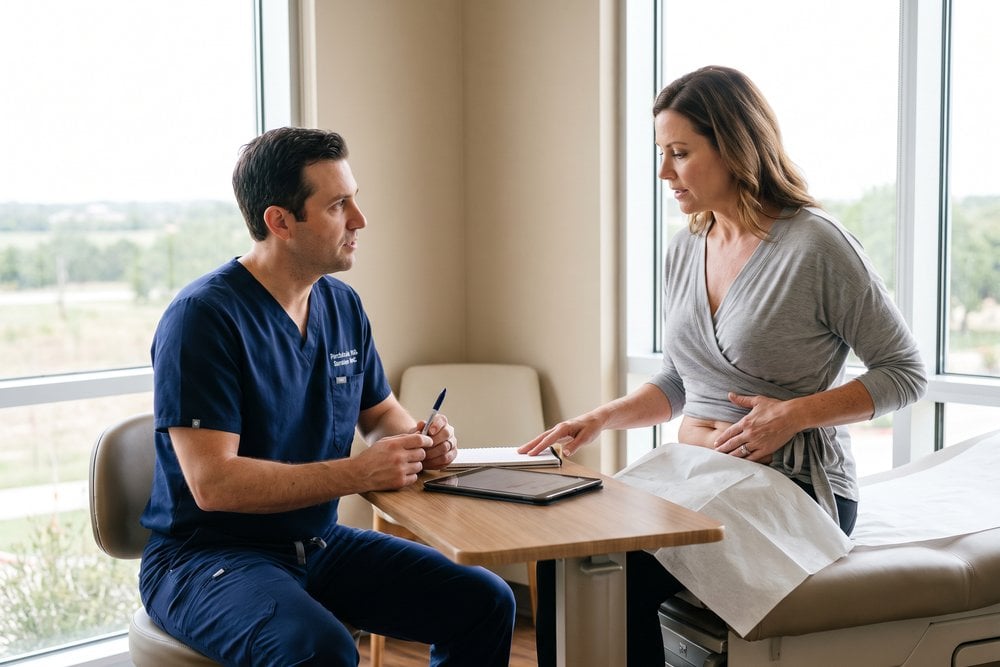
Over the past few years, I have met a new kind of patient. She (or he) has lost 40, 60, sometimes 100 pounds with a GLP-1 medication such as Ozempic, Wegovy, Mounjaro, or Zepbound. Blood pressure is better, knees hurt less, and clothes fit differently. Yet when they look down, the lower abdomen hangs, folds, or wrinkles in a way that no amount of exercise changes. If you are researching a tummy tuck in San Antonio after GLP-1 weight loss, this guide is written for you.
I want to give you the same information I share in a consultation: why the skin behaves the way it does, how to tell when your weight is stable enough for surgery, how a mini, full, and extended tummy tuck differ, when it makes sense to add liposuction or an arm lift, how to prepare your body nutritionally, and why your surgeon and anesthesia team must know about your medication. At the end there is a simple decision framework you can work through at home.
Why GLP-1 Weight Loss Leaves Loose Abdominal Skin
GLP-1 receptor agonists (semaglutide in Ozempic and Wegovy) and the dual GIP/GLP-1 agonist tirzepatide (Mounjaro and Zepbound) reduce appetite and slow stomach emptying. The result for many people is steady, substantial fat loss over months rather than years. That pace is good news for health, but it can be hard on the skin.
Skin is an organ with limited elasticity. When it has been stretched for years by excess weight, pregnancy, or both, the collagen and elastin fibers that let it spring back are often damaged. When the fat underneath shrinks, the skin envelope does not shrink in proportion. On the abdomen, this typically shows up as:
- A lower apron of skin (a pannus) that folds over the pubic area or the C-section scar
- Fine crepey wrinkling above and around the belly button
- Separation of the abdominal muscles (diastasis recti), especially in patients who have been pregnant
- Stretch marks that become more visible once the area deflates
- Rashes, chafing, or moisture problems under the fold in warm weather, something San Antonio summers make very real
People sometimes call this "Ozempic belly," but the medication itself does not damage skin. What matters is how much weight you lost, how quickly, your age, your genetics, sun exposure, smoking history, and how long the skin was stretched. Two patients who lose the same 50 pounds can have very different results, which is why a physical examination matters more than a before photo.
What exercise and skin tightening can and cannot do
Core strengthening improves posture and muscle tone, and I encourage it. Non-surgical energy-based treatments can modestly tighten mild laxity. Neither can remove a fold of excess skin or repair separated abdominal muscles. When the problem is true surplus skin, removal is the only reliable fix, and that is what abdominoplasty does.
Is Your Weight Stable Enough for Surgery? The Timing Question
The most common question I hear from GLP-1 patients is "When can I have surgery?" The honest answer is: when your weight has stopped moving, not on a calendar date.
Body contouring is planned around the tissue in front of me on the day of surgery. If you lose another 25 pounds after a tummy tuck, new laxity can develop and the result softens. If you regain weight, the tightened skin stretches again and fat can return around the repair. Neither outcome means the surgery failed, but both are avoidable with good timing.
What "stable" means in practice
Most plastic surgeons, myself included, look for weight that has held within a narrow range (often a few pounds up or down) for roughly three to six months. A practical way to check:
- Weigh yourself at the same time of day, once a week, for three months.
- Write the numbers down.
- If the trend line is flat rather than drifting down, you are approaching a stable plateau.
You should also be at, or close to, the weight you intend to maintain. Surgery is not a shortcut to a goal weight. It removes skin and refines contour once the weight work is done.
The dose question: are you still on the medication?
Here is the part that is unique to GLP-1 patients. Many people are still taking the medication at a maintenance dose, some are tapering, and some have stopped. Each situation changes the timing conversation:
- Still losing on a full dose: You are probably not ready yet. Keep going and revisit when the scale levels off.
- On a stable maintenance dose with steady weight: This can be a reasonable time to plan surgery, provided you intend to stay on that plan afterward.
- Recently stopped: Some people regain weight after stopping. I usually prefer to see how your body settles for a few months before operating.
- Planning to stop after surgery: Tell me. If regain is likely, it changes how I counsel you about long-term results.
If your medication is managed through a medical weight loss program, it helps to bring that provider into the conversation. Patients who started their journey with our weight loss injections service, or with their own physician, should share their dosing history so we can see the full picture.
Telling Your Surgeon About GLP-1 Medication (and Why It Matters for Anesthesia)
Please tell your surgeon and anesthesia provider that you take, or recently took, a GLP-1 medication, even if you think it is not relevant. It is.
The aspiration concern
GLP-1 medications slow how quickly the stomach empties. Under general anesthesia or deep sedation, the protective reflexes that keep stomach contents out of the lungs are suppressed. If food is still sitting in the stomach despite normal fasting, there is a risk of regurgitation and aspiration, which can cause a serious lung injury. Anesthesia societies have issued guidance on this, and that guidance has been updated as more evidence has come in.
What pausing the medication usually looks like
The exact plan is decided by your surgeon and anesthesia team, not by a blog. In general, depending on the drug, dose, and your symptoms, the plan may include:
- Holding a weekly injection for about a week before surgery, or holding a daily medication the day before or day of surgery
- A clear liquid diet for a period (often around 24 hours) before surgery
- Extra caution if you have active nausea, vomiting, bloating, or fullness, or if you are in the dose escalation phase
- A plan for when to restart the medication after surgery, once you are eating and drinking normally
Do not stop or change your medication on your own based on something you read. If you take a GLP-1 for type 2 diabetes, stopping it affects blood sugar, and your prescribing physician needs to be part of the plan. What matters is that everyone on your care team knows exactly what you take, at what dose, and when your last dose was.
Other health conditions that come up
Significant weight loss often improves conditions such as high blood pressure, diabetes, and sleep apnea, but it does not always resolve them. I will ask about each, review recent lab work, and may request clearance from your primary care physician. Smoking and nicotine in any form (including vapes and pouches) must stop well before and after surgery because they impair wound healing.
Mini vs. Full vs. Extended Tummy Tuck After Weight Loss
Not every post-GLP-1 abdomen needs the same operation. The right choice depends on where the loose skin is, whether the muscles have separated, and whether the laxity wraps around the flanks and back.
Mini tummy tuck
A mini tummy tuck removes a smaller amount of skin below the belly button through a shorter incision. The belly button usually is not repositioned. It works best for patients with a modest pouch below the navel, good skin above it, and little or no muscle separation. After large-volume weight loss, honestly, most patients have more laxity than a mini procedure can address. Choosing it only for a shorter scar can leave a loose upper abdomen.
Full tummy tuck (abdominoplasty)
A full abdominoplasty uses a low hip-to-hip incision, removes skin from the belly button down to the pubic area, tightens the abdominal muscles from the ribs to the pelvis, and brings the belly button through a new opening. This is the workhorse operation for most GLP-1 patients with moderate laxity on the front of the abdomen, especially when pregnancy has also stretched the muscles.
Extended tummy tuck
When loose skin and fat continue around the sides onto the flanks, the incision is lengthened to address that tissue too. An extended tummy tuck smooths the "love handle" overhang that a standard incision would leave behind. Patients who lost a very large amount of weight may need even more, such as a vertical component (sometimes called a fleur-de-lis pattern) to tighten horizontal laxity, or a circumferential lower body lift that includes the back and buttocks. These are bigger operations with longer recoveries, and they are discussed case by case.
Comparison table
| Feature | Mini tummy tuck | Full tummy tuck | Extended tummy tuck |
|---|---|---|---|
Best for | Small pouch below the navel | Loose skin above and below the navel | Loose skin wrapping onto the flanks |
Incision | Short, low, above the pubic area | Hip to hip, low on the abdomen | Beyond the hips toward the back |
Belly button | Usually unchanged | Repositioned | Repositioned |
Muscle repair | Lower abdomen only, if needed | Full length, ribs to pelvis | Full length, ribs to pelvis |
Typical GLP-1 candidate | Moderate weight loss, good skin quality | Moderate to large weight loss | Large weight loss with flank laxity |
Recovery | Shortest of the three | Moderate | Longest of the three |
Main limitation | Cannot treat upper abdominal laxity | Leaves flank laxity untreated | Longer scar and recovery |
Scar length is a real concern, and I understand why people want the shortest one possible. My view is that the scar should be as long as it needs to be to do the job, and placed low enough to hide under most underwear and swimwear. A slightly longer, well-placed scar with a smooth contour is usually a better trade than a short scar with leftover folds at the hips.
Combining a Tummy Tuck With Liposuction, an Arm Lift, or Other Procedures
GLP-1 weight loss rarely affects only the abdomen. The same deflation often shows up in the upper arms, thighs, breasts, and face. Many patients ask whether they should do everything at once.
Tummy tuck with liposuction
Even after major weight loss, stubborn fat can remain in the flanks, upper abdomen, or back. Liposuction can be used carefully alongside a tummy tuck to refine the waistline and blend the transition between treated and untreated areas. The key word is carefully. Liposuction removes fat, not skin, and aggressive liposuction in the same area that is being lifted can compromise blood supply to the skin flap. I tailor where and how much fat is removed to keep healing safe.
If you have very little fat left and mostly loose skin, liposuction alone will make looseness worse, not better.
Tummy tuck with an arm lift
Hanging upper arm skin is one of the most frequent complaints after GLP-1 weight loss. An arm lift (brachioplasty) removes that skin through an incision on the inner arm. Patients searching for an arm lift after weight loss in San Antonio often want to combine it with abdominal surgery to have one recovery instead of two. That can be reasonable for a healthy patient, but combining procedures adds operating time, and longer operations carry more risk of blood clots and other complications. Whether we combine or stage depends on your health, the total plan, and how much surgery is safe in one sitting. Arm scars run along the inner arm, so it helps to see examples before deciding whether the trade is worth it for you.
Tummy tuck with breast surgery
For mothers in particular, weight loss and previous pregnancies can leave both the abdomen and breasts deflated. Combining abdominoplasty with a breast lift, with or without implants, is the basis of what many people know as a mommy makeover. After GLP-1 weight loss, the planning is similar, with extra attention to weight stability and nutrition.
Staging versus combining
| Approach | Advantages | Trade-offs |
|---|---|---|
Combined in one surgery | One anesthesia, one recovery period, one block of time off | Longer operation, more demanding recovery, higher cumulative risk |
Staged over months | Shorter operations, easier individual recoveries, chance to reassess | Two or more recoveries and more total time away from work |
I often prioritize the area that bothers you most, or the one causing functional problems such as rashes, and plan the rest around it.
Nutrition and Protein Before a Tummy Tuck
This section matters more for GLP-1 patients than for almost anyone else. These medications reduce appetite so effectively that many people eat far less protein than they realize. Rapid weight loss can come with muscle loss, low iron, low vitamin levels, and in some cases low protein stores. Wounds are built from protein. A body that is undernourished heals more slowly and is more prone to wound separation, seromas, and infection.
What I ask patients to focus on
- Protein at every meal. Many surgeons suggest aiming for a substantial daily protein intake in the weeks before and after surgery, often well above what a low-appetite GLP-1 patient is eating. Your primary physician or a dietitian can set a target that fits your weight and kidney function.
- Easy protein sources when appetite is low. Greek yogurt, eggs, cottage cheese, fish, chicken, beans, tofu, and protein shakes are all practical. Small, frequent portions work better than trying to eat large meals.
- Hydration. GLP-1 medications can blunt thirst as well as hunger. Dehydration before surgery makes everything harder.
- Lab work. I may check a blood count and nutritional markers such as albumin or prealbumin. Low iron or anemia should be corrected before elective surgery.
- Strength training. Preserving muscle supports recovery and improves your final contour.
If you have had bariatric surgery in addition to medication, nutritional screening is even more important, because absorption of some vitamins and minerals is altered permanently.
Recovery Timeline After a Tummy Tuck
Every patient heals differently, and your instructions will be specific to your procedure. A general outline:
| Time after surgery | What to expect |
|---|---|
First few days | Soreness and tightness, walking slightly bent at the waist, short walks every few hours to reduce clot risk, possible drains |
Week 1 to 2 | Gradual increase in activity, compression garment, drains removed when output is low, many desk workers return around the end of this window |
Weeks 3 to 6 | Gradually standing straighter, light activity, no heavy lifting or core exercises, swelling fluctuates |
Weeks 6 to 8 | Clearance for most exercise, including core work, based on your examination |
3 to 12 months | Swelling continues to settle, scar matures from pink to flatter and lighter |
For GLP-1 patients, recovery is also when your eating habits are tested. If you had an arm lift at the same time, expect added arm swelling and limits on reaching and lifting. Restarting the medication, if that is the plan, should be coordinated with your surgeon and prescribing physician, especially if nausea could interfere with keeping up protein and fluids.
Self-Assessment: Are You Ready for a Tummy Tuck After GLP-1 Weight Loss?
Work through this checklist honestly before your consultation. The more items you can check, the closer you probably are to being a good candidate.
- My weight has been within a few pounds for at least three months.
- I am at, or near, the weight I plan to maintain.
- I know my medication name, current dose, and plan (continue, taper, or stop).
- My prescribing physician knows I am considering surgery.
- I do not smoke, vape, or use nicotine, or I am ready to stop well before surgery.
- I am eating enough protein most days, even with a reduced appetite.
- Chronic conditions such as diabetes or blood pressure are well controlled.
- I can arrange two weeks of reduced activity and help at home for the first several days.
- My main concern is loose skin or muscle separation, not fat I still hope to lose.
- I am not planning a pregnancy in the near future.
If several boxes are unchecked, that does not mean surgery is off the table. It means there is preparation to do first, and a consultation can help you build that plan.
A Decision Framework: Which Path Fits You?
Here is how I think through the decision with GLP-1 patients. Use it as a guide for your own questions.
Step 1: Is the weight done? If you are still losing, wait. If you have plateaued for three to six months, move to step 2.
Step 2: Is the medication plan settled? Know whether you will stay on a maintenance dose or stop. If you are stopping, give your body time to show whether it will hold your weight.
Step 3: Where is the excess skin? Below the navel only suggests a possible mini procedure. Above and below the navel points to a full tummy tuck. Wrapping onto the flanks points to an extended approach. Around the entire waist may require a lower body lift.
Step 4: Are the muscles separated? A bulge that persists even when you are lean, or a gap you can feel above the navel when you lift your head, suggests diastasis that should be repaired during a full abdominoplasty.
Step 5: What else bothers you? Arms, breasts, thighs, or remaining pockets of fat may be addressed at the same time or in stages. Rank them by how much they affect your daily life.
Step 6: Is your body ready to heal? Nutrition, labs, nicotine status, and medical conditions all need to be in good shape.
Step 7: Is the plan realistic for your life? Time off work, childcare, help at home, and budget. Patients often ask about tummy tuck cost in San Antonio and about tummy tuck financing. Fees depend on the procedures, surgical time, anesthesia, and facility, so an accurate quote comes after an examination. Our team can walk you through payments and financing options once your plan is defined.
Insurance, Medical Necessity, and Skin Removal Surgery in San Antonio
Patients searching for skin removal surgery in San Antonio sometimes ask whether insurance will cover it. A cosmetic tummy tuck, including muscle repair, is generally not covered. A panniculectomy, which removes an overhanging apron of skin without the cosmetic tightening of a tummy tuck, is occasionally covered when there is documented, persistent rash, infection, or functional impairment that has not responded to treatment. Coverage criteria vary widely by insurer and plan, so the only way to know is to check your own policy. Many patients choose a full cosmetic abdominoplasty because it addresses contour and muscle laxity that a panniculectomy does not.
Choosing a Surgeon for a Tummy Tuck in San Antonio After Weight Loss
When people search for the best plastic surgeon after weight loss, or the best tummy tuck surgeon in San Antonio, reviews and photos are a good starting point, but they are not the whole story. Questions worth asking:
- Is the surgeon board certified in plastic surgery?
- Will they examine you and explain which type of tummy tuck you need and why, including the trade-offs?
- Do they ask specifically about GLP-1 medications, dosing, and the timing of your last dose?
- Do they address nutrition, weight stability, and medical clearance before booking a date?
- Can they show before and after photos of patients with a similar amount of weight loss?
- Are they willing to tell you to wait if you are not ready?
That last question matters most. A surgeon who is comfortable saying "not yet" is protecting your result.
For patients traveling from Boerne, New Braunfels, the Hill Country, or farther away, plan for a stay near San Antonio for the first post-operative visits. Your care team can help you plan that stay.
How Dr. Ayala Approaches Tummy Tuck Surgery After GLP-1 Weight Loss
When you come in for a consultation about abdominoplasty in San Antonio after medication-assisted weight loss, the conversation starts with your story: how much you lost, over what period, which medication you used, and where things stand now. Then comes a careful examination of skin quality, the location and extent of laxity, muscle separation, scars from prior surgery, and the flanks and back.
From there, we build a plan that matches the operation to your anatomy rather than to a menu. Sometimes that is a single full abdominoplasty. Sometimes it is an extended tummy tuck with liposuction of the flanks, followed months later by an arm lift. Sometimes the right answer is to give it three more months and focus on protein and strength training first. Your medication history, last dose, and restart plan are reviewed with the anesthesia team before a surgery date is confirmed.
Frequently Asked Questions
How long should I wait after Ozempic or Wegovy weight loss before a tummy tuck?
Most plastic surgeons want your weight to be stable, usually within a few pounds, for about three to six months before a tummy tuck. The date you stopped losing matters more than the date you started the medication. If you are still losing on a full dose, it is usually better to wait, because further weight loss after surgery can create new loose skin and soften your result. Your surgeon will also want to know whether you plan to stay on a maintenance dose or stop, since that affects how stable your weight is likely to remain.
Do I need to stop my GLP-1 medication before surgery?
Often the medication is paused for a short period before surgery, but the exact plan comes from your surgeon and anesthesia team. GLP-1 drugs slow stomach emptying, which can raise the risk of aspiration under anesthesia. Depending on the drug and dose, the plan may involve holding a weekly injection for about a week, holding a daily dose around surgery, and following a clear liquid diet beforehand. Never stop the medication on your own, especially if you take it for diabetes, and always tell every member of your care team when your last dose was taken.
Can I keep taking Mounjaro or Zepbound after my tummy tuck?
Many patients do restart their medication after surgery, but timing should be coordinated with your surgeon and prescribing physician. In the first days of recovery, your priority is eating enough protein and staying hydrated, and nausea from restarting can make that harder. Once you are eating and drinking normally and your surgeon is comfortable with your healing, resuming a maintenance dose is often reasonable. Staying at a stable weight long term is one of the best ways to protect your tummy tuck result.
Is a mini tummy tuck enough after GLP-1 weight loss?
Sometimes, but not often. A mini tummy tuck only treats a small pouch of loose skin below the belly button and does not reposition the navel or tighten the upper abdominal muscles. After substantial weight loss, most patients have laxity above the navel too, and some have skin that wraps onto the flanks. In those cases a full or extended tummy tuck gives a smoother result. An in-person examination is the only reliable way to tell which procedure fits your anatomy.
Why does protein matter so much before a tummy tuck?
Your body uses protein to build new tissue and close wounds. GLP-1 medications reduce appetite so effectively that many patients eat much less protein than they need, and rapid weight loss can also reduce muscle and nutritional stores. Low protein and nutritional deficiencies are linked to slower healing and wound problems. Focusing on protein at each meal, staying hydrated, and correcting issues such as low iron before surgery helps your body heal well. Your physician or a dietitian can recommend a daily target suited to you.
Can I combine a tummy tuck with an arm lift after weight loss?
For healthy patients, combining a tummy tuck with an arm lift can be reasonable and means one recovery instead of two. However, every added procedure lengthens the operation, and longer surgeries carry higher risk of complications such as blood clots. Your surgeon will weigh your health, the total amount of surgery planned, and your recovery needs. Some patients do best with combined surgery, while others are safer staging procedures a few months apart.
Will liposuction alone fix my loose belly after Ozempic?
Usually not. Liposuction removes fat, not skin. If most of your remaining concern is loose, deflated skin, removing more fat can make the skin look looser. Liposuction is most useful as an addition to a tummy tuck, refining the flanks or upper abdomen, or for patients who have good skin elasticity and isolated pockets of fat. A consultation helps sort out how much of your concern is skin, how much is fat, and how much is muscle separation.
Does insurance cover skin removal surgery after weight loss?
A cosmetic tummy tuck is generally not covered by insurance. A panniculectomy, which removes an overhanging apron of skin, is sometimes covered when there is documented, persistent rash, infection, or functional impairment that has not improved with treatment. Requirements differ by insurer and plan, so check your own policy. Many patients choose a cosmetic abdominoplasty because it also tightens the muscles and improves contour, which a panniculectomy does not do.
How long is recovery from a tummy tuck after major weight loss?
Many patients with desk jobs return to work around two weeks after a full tummy tuck, though extended procedures or combined surgeries usually take longer. Heavy lifting and core exercise are typically restricted for about six weeks. Swelling continues to improve for several months, and the scar matures over the first year. Good nutrition, walking early to reduce clot risk, wearing your compression garment, and following your surgeon's instructions all support a smoother recovery.