

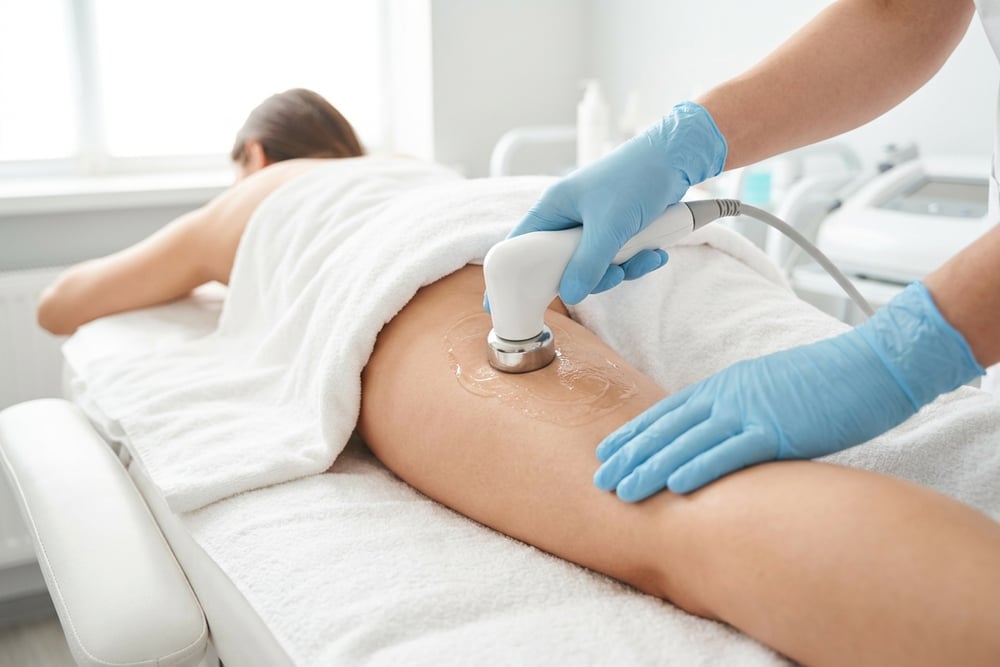
Cellulite is one of the most common concerns Dr. Ayala hears about in consultation, and one of the most commonly oversold. If you have been researching zWave in San Antonio, you have probably seen before-and-after photos that look almost too good, along with promises of "melting" fat or "tightening" skin. The aim of this guide is to give you a more grounded picture: what acoustic wave therapy actually does to tissue, what it can reasonably improve, what it cannot, and how it fits alongside surgical options when a patient's real concern turns out to be fat or loose skin rather than cellulite.
This guide also walks you through a self-check you can do at home before your visit. Many patients save time, money, and disappointment by figuring out, honestly, which of three problems they are trying to solve: dimpled texture, stubborn fat, or skin laxity. Each one has a different best answer.
What Cellulite Actually Is (and Why It Is So Common)
Cellulite is not a disease and it is not a sign that you are out of shape. It is a structural pattern in the skin and the fat just beneath it. Under the skin of the thighs, buttocks, and hips, fat sits in small compartments separated by fibrous bands called septae. In many women, these bands run vertically, tethering the skin downward while the fat lobules between them push upward. The result is the familiar "orange peel" or "cottage cheese" surface.
Several factors make cellulite more or less visible:
- Anatomy and sex. The majority of adult women have some degree of cellulite, partly because of how their connective tissue is arranged. Men have a crisscross pattern that hides dimpling more effectively.
- Skin thickness and quality. Thinner or less elastic skin shows the underlying pattern more clearly. This often becomes more noticeable with age and after pregnancy.
- Fat volume. More fat in a compartment pushes harder against the tethering bands, though even very lean women can have visible cellulite.
- Circulation and fluid. Areas with sluggish lymphatic drainage and fluid retention can look more uneven.
- Genetics and hormones. Family patterns are strong, and estrogen influences fat distribution and connective tissue.
This matters because any honest cellulite treatment is working on texture: the relationship between skin, septae, fat lobules, and fluid. It is not removing a large volume of fat, and it is not lifting skin that has stretched and sagged. Keeping that distinction clear is the single most important part of setting expectations.
How zWave Works: Acoustic Waves Explained Simply
zWave is a radial shockwave platform made by Zimmer, a medical device company. You may also see it called acoustic wave therapy, radial pressure wave therapy, or simply shockwave therapy. Similar technology has a long history in orthopedics and sports medicine for tendon problems, and over the last two decades it has been adapted for cosmetic body work.
What the device does
The treatment uses a handheld applicator that generates pulses of mechanical energy. A small projectile inside the handpiece is driven forward and strikes a transmitter at the tip, which sends a pressure wave into the tissue. The waves spread out (that is the "radial" part) and travel through skin and the superficial fat layer. Practitioners usually apply a gel and glide the applicator over the treatment area in a methodical pattern. Patients describe a rapid tapping sensation that most find tolerable without numbing.
What researchers think happens in the tissue
The proposed effects of acoustic wave therapy on cellulite include:
- Mechanical stimulation of connective tissue, which may encourage remodeling of the fibrous bands and the skin's collagen network over time.
- Improved local circulation and lymphatic flow, which may reduce fluid congestion that makes dimpling look worse.
- Changes in skin elasticity and firmness at the surface level, which can soften the appearance of texture.
Dr. Ayala is careful to add a caveat here. These mechanisms are reasonable and supported by laboratory and small clinical studies, but the published research on acoustic wave therapy for cellulite consists mostly of modest-sized trials, many without long follow-up. Several studies have shown measurable improvement in cellulite appearance and skin elasticity, and patient satisfaction in those studies has generally been positive. Results vary between individuals, and the evidence does not support claims of permanent elimination of cellulite or significant fat loss. When a practice tells you otherwise, that is a signal to ask more questions.
What zWave Can and Cannot Do
This is the section Dr. Ayala wishes every patient read before searching for zWave cellulite reduction. The technology is useful, but only when it is matched to the right problem.
What it can reasonably help with
- The appearance of mild to moderate cellulite on the thighs, buttocks, hips, and sometimes the abdomen and upper arms.
- Mild surface texture irregularity, the crepey or uneven feel that some patients notice on the backs of the legs.
- A smoother, more even look in the treated area, which many patients describe as their skin looking "calmer" or more uniform in photos and in certain lighting.
What it cannot do
- It does not remove fat in any meaningful volume. Some marketing uses the phrase zWave body sculpting, but acoustic wave therapy is not a fat reduction device in the way liposuction physically removes fat. If your main goal is a smaller measurement, it is not the right primary tool.
- It does not tighten loose, hanging skin. Skin that drapes or folds after pregnancy or weight loss needs either non-surgical skin tightening with energy-based devices (for mild laxity) or surgical removal (for moderate to severe laxity).
- It does not repair separated abdominal muscles. A rounded lower belly from diastasis recti is a structural issue that no external device can fix.
- It does not permanently erase cellulite. The underlying anatomy that causes cellulite stays with you. Improvement is real for many people but gradual and partial, and it fades without maintenance.
- It does not replace healthy weight management. Significant weight change will alter the treated area, for better or worse.
If you recognize your concern in the second list more than the first, that is not bad news. It just means the conversation should shift toward a different treatment, and he would much rather tell you that at the consultation than after six sessions.
Is zWave Right for You? A Realistic Expectation Self-Check
Before your appointment, stand in good lighting in front of a mirror and work through the questions below. Be honest with yourself. There are no wrong answers; the point is to sort your concern into the right category.
Part 1: What do you actually see?
- When I stand relaxed, I see dimpling or an orange-peel texture on my thighs or buttocks.
- When I gently pinch the skin, the dimpling becomes more obvious ("mattress phenomenon").
- When I lie down on my back, much of the dimpling softens or disappears.
- The skin itself is reasonably firm; it does not hang or fold when I stand.
If you checked most of these, you are describing cellulite, and acoustic wave therapy is a reasonable option to discuss.
Part 2: Is something else driving the concern?
- My main frustration is the size or shape of an area, not the texture.
- I can grab a thick handful of soft fat that does not change with diet and exercise.
- My skin hangs, folds, or creases, especially on the lower abdomen or inner thighs.
- My belly bulges or "domes" when I sit up, even though I am fairly lean.
Checking items in Part 2 suggests that volume, laxity, or muscle separation is part of the picture. zWave may still help texture, but it will not address these issues on its own.
Part 3: Are your expectations realistic?
- I understand improvement is usually gradual over several weeks.
- I am comfortable with a visible improvement rather than perfectly smooth skin.
- I can commit to a full series of sessions and some form of maintenance.
- I am at or near a stable weight that I expect to maintain.
If you can check all four in Part 3, you are the kind of patient who tends to be happy with acoustic wave therapy.
Who Is a Good Candidate for Cellulite Reduction in San Antonio
When Dr. Ayala evaluates someone asking about cellulite reduction in San Antonio, TX, he is looking at more than the dimples themselves. The patients who tend to do best usually share a few features:
- Mild to moderate cellulite rather than very deep, widespread dimpling combined with significant laxity.
- Reasonably good skin tone, without large areas of hanging skin.
- A stable weight and a lifestyle that supports it.
- Realistic goals focused on smoother texture rather than a different body shape.
- Good general health, with no contraindications in the treatment area.
Who should not have treatment, or should wait
Acoustic wave therapy is generally well tolerated, but it is not appropriate for everyone. Treatment is typically avoided or postponed during pregnancy, over areas with active infection, open wounds, or skin disease, and over areas with certain implanted devices. People with blood clotting disorders, those taking anticoagulant medication, people with a history of blood clots in the treatment area, and patients with active cancer in or near the area need individual medical evaluation, and in many cases treatment is not advised. Recently operated areas should be fully healed and cleared by the surgeon before any device work begins. He reviews your history in detail at the visit, and you should always mention any medications or supplements that affect bleeding.
This is also where it helps to understand the broader menu of non-surgical procedures available in San Antonio, because many patients come in for one thing and leave with a plan that sensibly combines two. The goal of a consultation is to match the treatment to the tissue in front of him, not to sell a package.
What to Expect From a zWave Treatment Series
The visit itself
A typical session is relatively short, often well under an hour depending on how many areas are treated. You will change into treatment garments, the area is cleaned, and a coupling gel is applied. The applicator is moved across the skin in overlapping passes. Settings can be adjusted for comfort, and most patients settle into the sensation within the first few minutes.
How many sessions
Acoustic wave therapy for cellulite is usually delivered as a series rather than a single appointment. A common approach is a set of sessions spaced about a week apart, though the exact number and spacing depends on the device protocol, the area treated, and how your tissue responds. Your treatment plan should be explained clearly before you start, including how progress will be measured. Dr. Ayala likes to take standardized photographs in the same lighting and position before the first session and after the series so that he and the patient are judging change objectively, not from memory.
No downtime, with a few minor effects
One of the reasons patients choose zWave is that there is no downtime in the usual sense. Most people return to work, errands, and normal activity the same day. Mild redness in the treated area is common and typically settles within hours. Some patients notice temporary tenderness or minor bruising, especially on the inner thighs or in people who bruise easily. Rarely, there may be temporary skin irritation. Because the treatment does not involve incisions, needles, or anesthesia, there is no wound care and no recovery period.
When results appear
Because the proposed mechanism involves gradual tissue remodeling, results are rarely instant. Changes generally become more apparent over the weeks after the series is complete. Staying well hydrated, keeping weight stable, and remaining physically active are all sensible habits that support the result, though none of them is a guarantee.
zWave vs Liposuction vs Tummy Tuck vs Skin Tightening
Patients often ask how acoustic wave therapy stacks up against surgery or other devices. The honest answer is that these treatments solve different problems, so the table below is less a ranking and more a map. If you have been searching for body contouring near me and feel overwhelmed by options, start by identifying which row matches your concern.
| Feature | zWave (acoustic wave) | Liposuction | Tummy tuck | Non-surgical skin tightening |
|---|---|---|---|---|
Primary target | Cellulite appearance and mild surface texture | Localized, diet-resistant fat | Loose abdominal skin, excess fat, separated muscles | Mild skin laxity and texture |
Removes fat? | No meaningful volume | Yes, physically removed | Yes, with the excised skin (often combined with liposuction) | No meaningful volume |
Treats loose skin? | No | No, and can unmask laxity | Yes, removes it | Mild improvement only |
Repairs muscle separation? | No | No | Yes, when indicated | No |
Anesthesia | None | Yes | Yes | Usually none or topical |
Incisions and scars | None | Small incisions | Lower abdominal scar | None |
Downtime | None | Days to a few weeks | Several weeks | Typically minimal |
Sessions | Series of sessions | Usually one procedure | One procedure | Often a series |
Durability | Gradual, needs maintenance | Removed fat cells do not return, but remaining fat can grow with weight gain | Long lasting with stable weight | Gradual, may need maintenance |
Best for | Dimpling on firm skin at a stable weight | Bulges of fat in good-quality skin | Post-pregnancy or post-weight-loss abdomen | Early laxity, crepey skin |
When liposuction makes more sense
If you are bothered by a distinct bulge, such as outer thigh "saddlebags," flanks, or a lower belly pooch that does not respond to diet and exercise, the issue is fat volume. Liposuction in San Antonio removes that fat directly and changes the contour in a way no external device can match. It is important to understand, though, that liposuction does not reliably treat cellulite. In some patients, removing fat beneath already lax skin can make surface irregularities more noticeable, which is one reason careful patient selection matters. Many people searching for non-surgical fat reduction in San Antonio, TX are describing a problem that only surgical fat removal will meaningfully change.
When a tummy tuck is the honest answer
When the main issue is loose, overhanging skin on the abdomen, often with stretch marks below the belly button and a rounded profile from separated muscles, the anatomy calls for surgical correction. A tummy tuck (abdominoplasty) removes excess skin, tightens the abdominal wall when indicated, and reshapes the midsection. Acoustic wave therapy cannot do any of these things. It is not a "non-surgical tummy tuck," regardless of how some advertising frames body devices.
Similarly, for patients asking about a body lift in San Antonio after major weight loss, the volume of loose skin almost always exceeds what any non-surgical device can address. In those cases, zWave is at most a finishing touch on texture, and usually not the first priority.
When skin tightening is the better match
There is a middle ground: skin that is a little loose or crepey but not hanging. This is common on the inner thighs, above the knees, the abdomen after pregnancy, and the arms. For that pattern, energy-based skin tightening is designed to stimulate collagen and firm the skin modestly. Patients searching for skin tightening in San Antonio often have both mild laxity and some cellulite, and in those cases a combined or sequential plan can make sense. Skin tightening devices and acoustic wave therapy work through different mechanisms, so one does not substitute for the other.
Can zWave Lift or Shape the Buttocks?
Dr. Ayala is asked fairly often whether zWave can serve as a non-surgical BBL in San Antonio. The direct answer is no. Acoustic wave therapy can improve the appearance of cellulite on the buttocks and the backs of the thighs, which can make the area look smoother in clothing and swimwear. It does not add volume, change projection, or lift tissue that has descended.
For patients who want more shape or lift, surgical options such as a buttock lift or gluteal augmentation address the structure directly. Some patients choose to combine approaches: surgery for contour, and acoustic wave sessions later for surface texture once they have healed. Others decide smoother skin is all they wanted. Both are reasonable choices.
Combining zWave With Surgery
Acoustic wave therapy can play a supporting role in a broader body contouring plan. Here is how Dr. Ayala generally thinks about combining it with surgery, with the caveat that every plan is individualized.
Before surgery
For a patient who is planning liposuction or a tummy tuck in the future, it usually makes more sense to complete the surgery first and evaluate the remaining texture afterward. Surgery changes the tissue substantially, and treating cellulite in an area that will be reshaped can mean paying for sessions whose effect is hard to judge.
After surgery
Once the surgical areas have fully healed and the surgeon has cleared them, some patients choose acoustic wave therapy to address residual dimpling, particularly on the thighs and buttocks, which are often adjacent to areas treated with liposuction. The timing is a medical decision. Treating too early, over healing tissue, swelling, or fresh incisions, is not appropriate. Dr. Ayala prefers to wait until swelling has settled enough to see the true result, which typically means a period of months rather than weeks.
Alongside other non-surgical treatments
Some patients pair acoustic wave sessions with skin tightening treatments when both texture and mild laxity are present. Others are working on overall weight with medical support. If you are currently losing weight with medical weight loss injections, he generally recommends reaching or approaching your goal weight before investing in cellulite treatment, because ongoing weight change will alter the skin and fat in the treated area. Rapid weight loss can also make skin laxity more noticeable, which may shift the priority toward tightening or, eventually, surgical skin removal.
Maintenance: Keeping Results Over Time
Cellulite reflects your underlying anatomy, and that anatomy does not change permanently with any non-surgical treatment. For that reason, results from acoustic wave therapy are generally considered gradual and temporary, and many practices recommend periodic maintenance sessions after the initial series. How often depends on how you respond, how much your weight fluctuates, and your own goals. Some patients choose a maintenance session every few months; others come back only before a vacation or event. Your practitioner should help you set a schedule based on your actual results, not a fixed sales plan.
There are also everyday habits that support the look of smoother skin:
- Keep your weight stable. Fluctuations stretch the connective tissue and change fat compartment volume.
- Stay active. Strength training for the legs and glutes improves muscle tone beneath the area, which can make the surface look firmer.
- Protect your skin. Sun damage weakens collagen. Sun protection on exposed legs matters, especially with San Antonio's long, hot summers.
- Do not smoke. Smoking impairs circulation and collagen quality.
Planning zWave in San Antonio: Timing, Climate, and Practical Tips
There are a few local considerations worth thinking about if you are planning treatment here.
Plan backward from shorts season. San Antonio's warm months start early and run long, and shorts and swimwear are part of daily life for much of the year. Because results develop gradually after a series, starting in late winter or early spring gives you time to complete sessions and see the change before the heat arrives. Starting in May for a June trip is often too late.
Expect mild redness, not downtime. You can schedule sessions around work, school drop-offs, or lunch breaks. If you are attending an event where your legs will be visible, avoid booking a session the same day in case of temporary redness.
Ask about cost structure up front. Acoustic wave therapy is usually priced per session or per series, and maintenance is an ongoing cost to budget for. The team can walk you through payment and financing options so that you can decide comfortably, without pressure, whether a full series makes sense for you.
Questions to Ask Any Provider Before Starting zWave
Whether you come to Dr. Ayala's practice or another one, these questions will help you separate a careful plan from a sales pitch:
- What device are you using, and who will perform the treatment? You should know whether it is the Zimmer zWave platform or a different acoustic wave device, and who is trained to operate it.
- What is my concern, in your assessment? A good provider will tell you whether you have cellulite, fat, laxity, or a combination.
- How many sessions do you recommend, and why? The answer should be based on your tissue, not a standard package for everyone.
- How will we measure results? Standardized photographs are the minimum.
- Do I have any reason not to be treated? Medications, medical history, and recent surgery all matter.
- What maintenance will I need, and what does it cost? Factor that into your decision from the beginning.
How Dr. Ayala Approaches Cellulite and Body Contouring
Dr. Ayala evaluates body concerns with the full range of options in mind, surgical and non-surgical. That perspective matters with cellulite, because the most common reason patients are disappointed with any cellulite treatment is that the treatment was mismatched to the problem. At your visit, he examines the area standing and lying down, assesses skin quality and laxity, looks for localized fat and muscle separation, and talks through what you want to change and why. If acoustic wave therapy fits, he will discuss a series and a realistic maintenance plan, and the team will show you how the sessions are structured in the office.
Dr. Ayala’s goal is that you leave the consultation understanding your own anatomy and your options, whether or not you decide to proceed. If you are ready to talk through your concerns in person, you can request a consultation with Dr. Ayala and the practice's team will help you find a time that works.
Frequently Asked Questions
Does zWave really work for cellulite?
For many patients with mild to moderate cellulite, acoustic wave therapy produces a visible improvement in the smoothness of the skin. The published studies are mostly modest in size and follow-up, so the evidence supports a realistic expectation of partial, gradual improvement rather than complete elimination. Results vary from person to person. The patients who tend to be happiest have dimpling on reasonably firm skin, a stable weight, and goals focused on texture rather than a different body shape. A careful in-person assessment is the best way to predict how you are likely to respond.
How many zWave sessions will I need?
Acoustic wave therapy is generally delivered as a series of sessions rather than a single visit, commonly spaced about a week apart. The exact number depends on the area treated, the severity of the cellulite, the device protocol, and how your tissue responds. Your plan should be explained before you start, with standardized photographs taken so progress can be judged objectively. Many patients also choose periodic maintenance sessions afterward to help keep the improvement, since the underlying anatomy that causes cellulite does not change permanently.
Is there any downtime after zWave?
There is no downtime in the usual sense. Most patients return to work and normal activities immediately after a session. Mild redness in the treated area is common and usually fades within hours. Some people notice temporary tenderness or light bruising, particularly on the inner thighs or if they bruise easily. There are no incisions, needles, or anesthesia, so there is no wound care. If your legs will be on display at an event, it is sensible to avoid scheduling a session on the same day.
Does zWave remove fat or help with weight loss?
No. Acoustic wave therapy is designed to improve the appearance of cellulite and surface texture, not to remove fat in any meaningful volume. If your main concern is a localized bulge of diet-resistant fat, liposuction is the treatment that physically removes it. If you are working on overall weight, it usually makes sense to reach a stable weight before investing in cellulite treatment, because ongoing weight change alters the skin and fat in the treated area and can affect your result.
Can zWave tighten loose skin on my stomach or thighs?
Acoustic wave therapy may modestly improve skin firmness at the surface level, but it does not tighten loose, hanging skin. Mild crepiness may respond better to energy-based skin tightening, while moderate to severe laxity, especially on the abdomen after pregnancy or major weight loss, usually requires surgical removal of skin. A tummy tuck is the standard approach when loose abdominal skin and separated muscles are the main problem. Identifying which issue you have is the first step in choosing the right treatment.
Does zWave hurt?
Most patients describe the sensation as a rapid tapping or thumping that is noticeable but tolerable. Numbing is generally not needed. The intensity can be adjusted during the session, and areas with less padding, such as the outer thighs near bone, may feel more sensitive than the buttocks. Some patients feel mild tenderness afterward that resolves on its own. If you have a low tolerance for discomfort, let your provider know at the start so settings can be adapted while still delivering an effective treatment.
How long do zWave results last?
Results are generally considered gradual and temporary because the fibrous bands and fat compartments that cause cellulite remain part of your anatomy. How long improvement lasts varies with weight stability, age, skin quality, activity level, and hormones. Many practices recommend maintenance sessions every few months or before seasons when you want your legs to look their best. Keeping a stable weight, staying active, protecting skin from sun damage, and not smoking are sensible habits that help support the result.
Who should not have zWave treatment?
Treatment is typically avoided or postponed during pregnancy and over areas with infection, open wounds, or active skin disease. People with clotting disorders, those on blood-thinning medications, anyone with a history of blood clots in the treatment area, and patients with active cancer in or near the area need individual medical evaluation, and treatment is often not advised. Areas that have recently had surgery must be fully healed and cleared by the surgeon first. Always share your full medication and medical history at the consultation.
Can I combine zWave with liposuction or other procedures?
Yes, in selected patients and with appropriate timing. Some patients choose acoustic wave therapy after liposuction or other body surgery to address remaining dimpling on the thighs or buttocks, once the surgical area has fully healed and swelling has settled. Others pair it with non-surgical skin tightening when both texture and mild laxity are present. Generally, it is better to complete planned surgery first and then evaluate what texture concerns remain, rather than treating an area that will soon be reshaped.
Is zWave a non-surgical BBL?
No. Acoustic wave therapy can improve the look of cellulite on the buttocks and backs of the thighs, which may make the area appear smoother in clothing and swimwear. It does not add volume, increase projection, or lift tissue that has descended. Patients who want more shape or lift should discuss surgical options for buttock contouring. Some patients choose surgery for contour and later add acoustic wave sessions for surface texture once they have fully healed.