

Most patients who ask about fat transfer have already seen the highlight reel: a set of dramatic before-and-after photos promising a bigger, fuller result using nothing but "your own fat." What they haven't usually seen is the fine print - that a meaningful portion of that transferred fat doesn't survive, that results take months to fully reveal themselves, and that fat transfer is a fundamentally different tool than an implant, not a free upgrade to one. Understanding both sides of that story is the whole point of this guide.
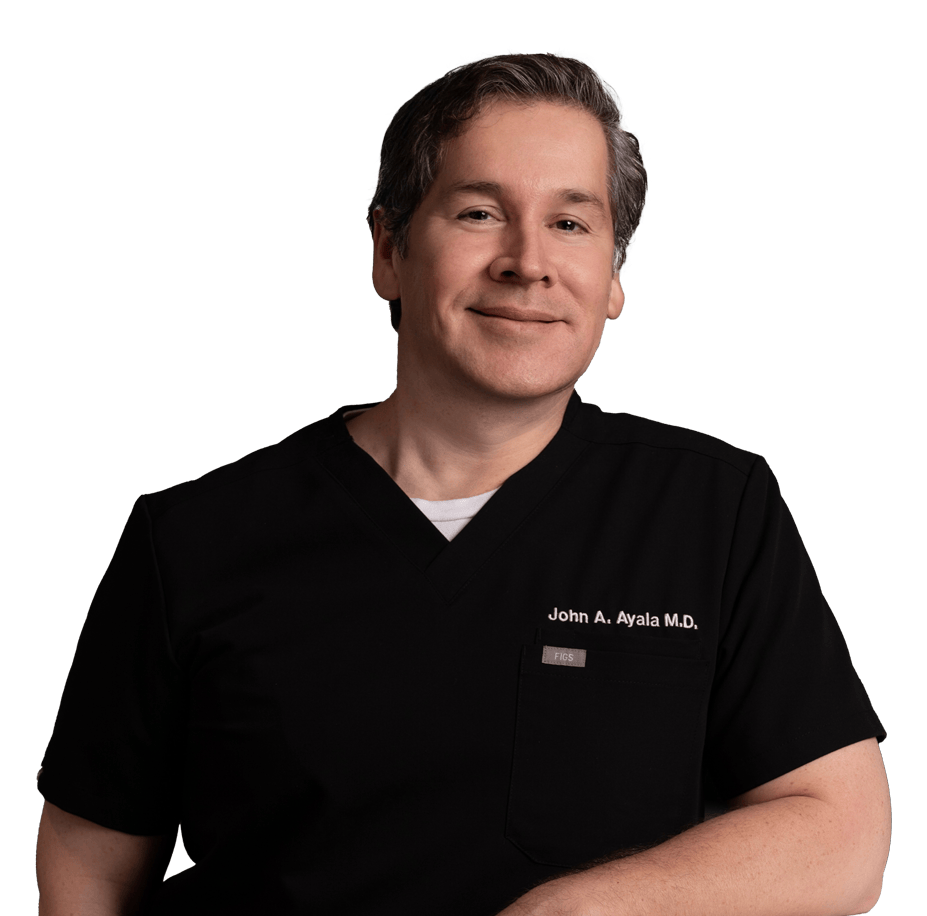
Fat transfer, also known as fat grafting or lipofilling, is a two-step procedure that removes fat from one part of the body through liposuction and reinjects it into the face or breasts to restore or add volume. It's performed in San Antonio by board-certified plastic surgeon Dr. John Ayala, MD, FACS, who works with patients to figure out - honestly - whether fat transfer is the right tool for their specific goal, or whether an implant, filler, or lift would serve them better.
Where the Fat Comes From
Liposuction supplies the raw material for any fat transfer procedure. Common donor sites are the abdomen, flanks, thighs, and back - generally wherever you have enough excess fat to harvest and, often, wherever you'd also welcome a bit of contouring as a side benefit. Because a liposuction step is always built into fat transfer, the donor area frequently ends up looking a little smoother and more contoured as a secondary outcome of the surgery, even though the face or breast is the primary goal.
Once removed, the fat isn't simply reinjected as-is. It goes through a purification process, usually centrifugation or filtration, that separates viable, structurally intact fat cells from the tumescent fluid, blood, and damaged cells that come along with any liposuction harvest. Only that purified fraction gets used - everything else is discarded. This step matters more than most patients realize, because the quality of the purification directly affects how much of the graft survives.
The Face: Where Volume Loss, Not Sagging, Is the Problem
Aging faces lose volume long before they visibly sag - hollow temples, flattened cheeks, deepening nasolabial folds, and thinning lips are often volume problems wearing a disguise as "looking tired." Fat transfer addresses this directly by rebuilding structure in these areas using your own tissue, rather than lifting or tightening skin that hasn't actually loosened yet.
The best facial fat transfer candidates are dealing primarily with volume loss rather than laxity. If skin has genuinely started to sag - not just thinned out - fat alone won't correct that, and a conversation about combining fat transfer with a facelift is usually more productive than fat transfer on its own. Smoking is a particular concern for facial candidates specifically, since it impairs the small blood vessels the graft depends on to survive in its new location.
The Breast: A Smaller, More Natural Alternative to Implants
Fat transfer to the breast - sometimes marketed under the somewhat misleading label "natural breast augmentation" - uses the same harvest-and-purify process, with fat reinjected across the breast in dozens of small, deliberate passes rather than one large deposit. It's a common choice for patients who:
- Want a modest, subtle size increase without a synthetic implant
- Are trying to correct minor asymmetry, rippling, or a divot left > behind from a prior surgery
- Want to soften or fill the upper pole after implant removal
- Would rather avoid the ongoing implant-specific monitoring that > comes with saline or silicone devices
The honest expectation to set here: breast fat transfer typically delivers something in the neighborhood of one cup size, occasionally a bit more. Patients hoping for a dramatic size increase are almost always better served by traditional implants, which remain the more predictable path to significant volume change.
A Closer Look: Facial Fat Transfer by Area
The face doesn't age uniformly, and neither does the answer to "where should fat go." The temples are one of the earliest areas to hollow, and even a small amount of restored volume there tends to soften the overall look of the upper face noticeably. The cheeks are the classic fat transfer target - reintroducing volume to the mid-face lifts the visual weight of the face upward, which can indirectly soften the appearance of nasolabial folds and jowls without touching either directly. Under-eye hollows respond well to fat transfer in the right candidate, though this is one of the more technically demanding areas to treat precisely, since the skin there is thin and unforgiving of any unevenness. The nasolabial folds themselves can be softened with direct fat placement, though a fold that's primarily caused by skin laxity rather than volume loss won't fully resolve with fat alone. Lips are a smaller-volume, higher-precision application, more often handled with filler for its adjustability, though some patients do choose fat for longer-lasting, natural-feeling volume.

Implants vs. Fillers vs. Fat: Three Different Tools
It's worth being direct about how fat transfer fits alongside the two procedures it's most often compared to.
Against implants, fat transfer offers a softer, more natural feel and avoids introducing a medical device - but it can't match an implant's precision or its capacity for a large size increase, and the final volume isn't entirely predictable until months after surgery.
Against dermal fillers, fat transfer is a genuine surgical procedure requiring an operating room and a real recovery, not an in-office injection - but the payoff is that surviving fat behaves like permanent tissue, while fillers are gradually metabolized over months and need to be repeated to maintain results.
Neither comparison has a universal winner. The right choice depends on how much correction is needed, how much downtime is realistic, and whether a donor-site contouring benefit is something you'd value.
The Purification Debate: Why Technique Matters
Not all fat purification methods are created equal, and this is one of the more technical decisions your surgeon makes on your behalf. Centrifugation - spinning harvested fat at high speed to separate it by density - is the most widely used method and tends to produce a concentrated, viable fat layer, though some surgeons argue the mechanical force involved can damage a portion of the fat cells in the process. Filtration and simple decantation (letting the fat settle and separate by gravity) are gentler alternatives that some surgeons prefer for exactly that reason, at the cost of being somewhat less efficient at removing unwanted fluid. There's genuine, ongoing debate in plastic surgery about which method delivers the best long-term survival, and the honest answer is that surgical skill in the reinjection step probably matters more than which purification method is used. It's a reasonable question to ask during your consultation, if only to understand how your surgeon thinks about graft survival.
Who Fat Transfer Isn't Right For
Fat transfer gets marketed as a universally "natural" option, which can obscure the fact that it's genuinely not the best fit for everyone. Patients with very low body fat may simply not have enough donor material to harvest a meaningful volume - in these cases, pushing for fat transfer anyway often means a smaller, less satisfying result than the patient expected going in. Smokers face a real, measurable increase in graft failure risk, since nicotine constricts the small blood vessels the transferred fat depends on to survive; most surgeons will ask patients to quit for a meaningful window before and after surgery, not as a formality but because it directly affects outcomes. And patients whose primary concern is sagging skin rather than lost volume tend to be disappointed with fat transfer alone, since it adds fullness without lifting anything - a facelift or breast lift addresses a fundamentally different problem than fat transfer does.
Combining Fat Transfer With Other Procedures
Fat transfer is frequently one piece of a larger surgical plan rather than a standalone procedure. It's commonly paired with:
- A > facelift, > addressing volume loss and skin laxity together
- A breast > lift, > when a patient wants both repositioning and modest added fullness
- Liposuction > at additional body sites beyond what's needed purely for fat > harvest, when a patient is already interested in broader > contouring
- Breast implant revision, using fat transfer to camouflage rippling > or fill in contour irregularities around an existing implant
Because the liposuction component of fat transfer is essentially "free" contouring at the donor site, patients considering multiple procedures sometimes find that combining fat transfer with another surgery is more efficient - one recovery period instead of two - than scheduling them separately.
What Actually Happens During Surgery
- Your surgeon identifies donor site(s) based on available fat and > your contouring goals.
- Fat is harvested using a gentle liposuction technique, chosen > specifically to preserve fat cell viability rather than maximize > removal speed.
- The harvested fat is processed to separate healthy cells from fluid > and debris.
- Purified fat is reinjected in small, layered passes into the face or > breast - spreading it thinly maximizes contact with existing > blood supply, which is the single biggest factor in how well the > graft survives.
- Donor sites are treated much like a standard liposuction recovery; > recipient sites are often more comfortable than patients expect, > since the injection technique is less invasive than placing an > implant.
The Honest Numbers on Fat Survival
Here's the part that separates realistic expectations from marketing photos: not all transferred fat survives. Published research on fat grafting reports survival rates generally in the 40% to 70% range, varying by treatment area, technique, and patient-specific factors - facial transfers, which use smaller and more precise volumes, tend to retain more than larger-volume breast or body transfers. Because of this, surgeons routinely overfill the treated area at the time of surgery, anticipating some reabsorption over the following months. Some patients also choose a second, smaller session later to build on the results of the first once they can see exactly how much of the initial graft survived.
This is genuinely the most important thing to understand before scheduling fat transfer: it is not a guaranteed, exact final volume the way an implant is. Results vary from patient to patient based on smoking status, donor fat quality, surgical technique, and how the recipient site heals.
Recovery, Week by Week
- Days 1–3: Swelling and bruising at both donor and recipient > sites - the treated area often looks temporarily larger than the > eventual result.
- Week 1–2: Visible swelling begins to recede; most patients are > back to non-strenuous routines.
- Week 3–4: Continued softening; a clearer picture of your > outcome starts to emerge, though it's still not final.
- Month 3–6: Fat grafts finish "taking" - the surviving cells > have established a stable blood supply and settled into what will > be their long-term volume.
Planning Recovery Around San Antonio's Climate
One practical detail patients don't always think about: San Antonio's warm climate for much of the year means compression garments and limited sun exposure at the donor site require some planning, particularly if your recovery window falls during the summer months. Swelling and bruising at liposuction donor sites can take a few weeks to fully resolve, and direct sun on healing incisions increases the risk of visible scarring or pigmentation changes. Scheduling around a stretch where you can reasonably stay out of direct sun, and being prepared to wear compression garments comfortably in the heat, is a small but real part of planning fat transfer surgery here rather than somewhere with a milder climate.
What Can Go Wrong (and How Often)
- Fat necrosis: In a minority of cases, transferred fat that fails > to establish blood supply forms small firm areas or > calcifications, occasionally requiring later removal.
- Uneven or asymmetric results: Because graft survival isn't > perfectly uniform, some patients end up needing a touch-up session > to even out results between sides.
- Donor-site contour irregularities: As with standalone > liposuction, uneven fat removal at the donor site is possible, > though experienced technique minimizes this.
- Limited by available fat: Very lean patients may simply not have > enough donor fat to harvest for a meaningful transfer, making them > better candidates for implants or fillers instead.
Myths Worth Retiring
A few misconceptions come up often enough in consultations that they're worth addressing directly. First: "it's my own fat, so there's zero risk." Fat transfer is genuinely safer in some respects than a foreign implant - there's no risk of an allergic reaction to the material itself, for instance - but it's still a surgical procedure with real risks, including the anesthesia, incision sites, and the possibility of fat necrosis discussed above. Second: "the results are exactly what I see the day after surgery." They aren't - early results are inflated by swelling, and the true outcome only becomes clear months later, after the body has reabsorbed the fat that didn't survive. Third: "fat transfer is basically the same as an implant, just natural." It isn't a substitute in that sense - implants offer a level of precision and scale that fat transfer, by its biological nature, can't match, particularly for patients seeking a significant size increase.
The Consultation Conversation That Actually Matters
A good fat transfer consultation spends less time on before-and-after photos and more time on a fairly unglamorous set of questions: How much donor fat do you realistically have? What's your smoking history, and are you willing to quit if needed? Is your primary concern volume loss, sagging skin, or both? Are you comfortable with a result that may take a second session to fully achieve? Patients who go into surgery with clear, calibrated expectations on these points are consistently the most satisfied afterward - which is really the whole point of a guide like this one.
Frequently Asked Questions
How much bigger will my breasts get with fat transfer?
Most patients see roughly a one cup size increase, occasionally somewhat more depending on available donor fat and how well the graft survives. It's a subtler change than implants and suits patients seeking modest enhancement rather than dramatic size increase.
Is fat transfer permanent?
The fraction of fat that survives and establishes a blood supply - generally 40% to 70% depending on the area - behaves like permanent fat going forward. The rest is naturally reabsorbed over the months after surgery, which is why final results aren't judged until several months out.
Can fat transfer replace a facelift?
No. Fat transfer restores lost volume; it doesn't tighten sagging skin. Many patients pair fat transfer with a facelift to address both volume and laxity in one plan.
Do I need enough fat elsewhere on my body to be a candidate?
Yes. Fat transfer depends on a donor site with sufficient harvestable fat. Very lean patients sometimes don't have enough available and may be steered toward implants or fillers instead.
Is fat transfer to the breast safe?
It's a well-established technique with a solid safety record, though like any surgery it carries risks such as fat necrosis or uneven absorption. A thorough consultation covering your health history and smoking status helps your surgeon plan the safest approach.
How long until I see my final results?
Because a portion of the transferred fat is reabsorbed, final results are typically judged around three to six months post-surgery, once swelling has resolved and the surviving fat has stabilized.