

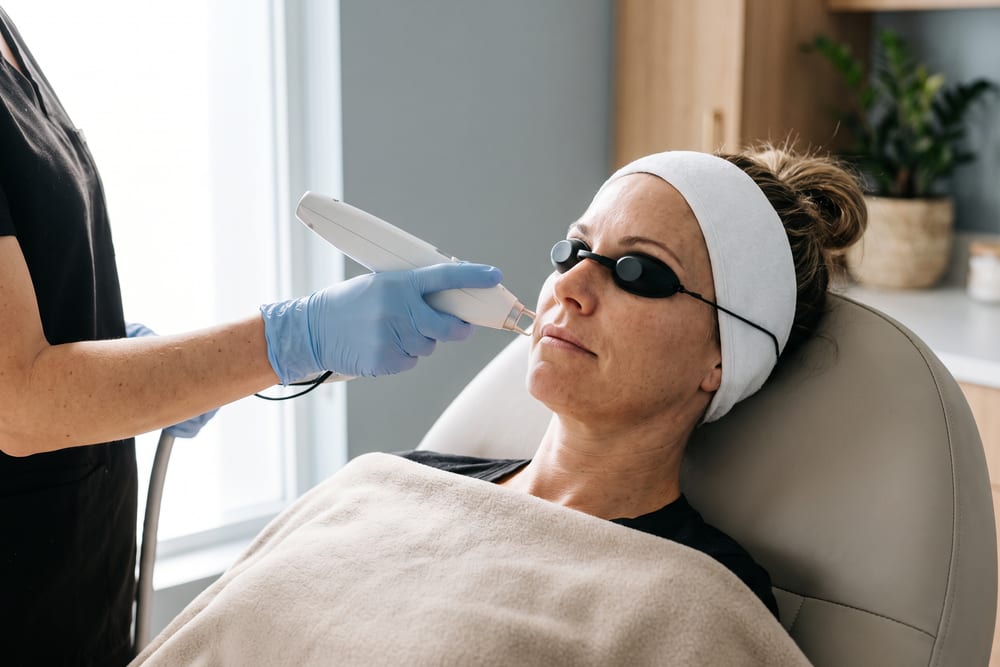
Most laser consultations in San Antonio begin the same way. A patient sits down and names a device. They read about it, saw it on social media, heard a friend describe a weekend of redness followed by glowing skin, and arrived ready to book that specific machine. The request is reasonable. It is also, almost always, the wrong place to start.
Dr. John Ayala, a board certified plastic surgeon practicing in San Antonio, approaches the conversation from the opposite end. The device is the last decision, not the first. Before any platform is chosen, three questions have to be answered in order: which layer of the skin actually holds the problem, which target within that layer the problem lives in, and only then which device reaches that layer and hits that target. Skip the first two and the third becomes a guess dressed up in technical language.
This matters more than it sounds. A patient who books an aggressive resurfacing treatment for a concern that lives in the fat pads under the cheek will heal beautifully and look exactly the same. A patient who books a pigment device for diffuse redness will spend money and recovery time on a treatment that was never aimed at their problem. The frustration that follows gets blamed on the laser. The real failure happened in the sequencing.
Step one: which layer of skin holds the problem
Skin is not one thing. It is a stack, and the stack is the single most useful mental model a patient can bring to a laser consultation.
The epidermis is the top layer, roughly as thick as a sheet of paper across most of the face. It holds pigment cells, it holds the dead cell layer that scatters light and makes skin look dull, and it is where surface texture lives. Brown spots from two decades of Texas sun, uneven tone, roughness, that papery look across the cheekbones: epidermal problems, almost entirely.
The dermis sits beneath it and is far thicker. Collagen and elastin live here, along with blood vessels, oil glands and hair follicles. Wrinkles that persist when the face is at rest, mild to moderate laxity, acne scarring, surgical scars, enlarged pores and crepey texture are dermal problems. They are not fixed by polishing the surface, because the structural defect sits below the surface. Treating them requires energy that penetrates past the epidermis and provokes new collagen formation in the dermis itself.
Below both layers sits subcutaneous fat, and below that, muscle and bone. This is where facial volume lives, and this is the layer no laser addresses in any meaningful way. Hollow temples, flattened midface, deflated cheeks, the shadow that forms under the eye as the fat pad descends: none of these respond to light energy. A laser can improve the quality of skin draped over a deflated structure. It cannot refill the structure. Patients whose primary concern is volume loss are better served by a conversation about facial fat grafting or other volumizing approaches, and it saves everyone time to establish that early.
This one distinction eliminates most mismatched expectations before a device is ever discussed. The honest version of the consultation is often a sorting exercise: the patient lists six concerns, and they get sorted into epidermal, dermal and structural piles. Each pile has a different answer, and only two of the three involve a laser.
Step two: which target the problem lives in
Once the layer is identified, the next question is what the energy will actually hit. Lasers do not treat skin in a general sense. They deliver a specific wavelength of light that is absorbed preferentially by a specific substance in the tissue. That substance is called a chromophore, and there are three that matter in aesthetic practice.
Melanin is the pigment chromophore. Devices tuned to melanin absorption are the ones that address brown spots, sun freckling, age spots and some forms of melasma. The light passes through surrounding tissue relatively harmlessly and dumps its energy into the pigment itself, which fragments or rises to the surface and sheds.
Hemoglobin is the vascular chromophore. Devices tuned to hemoglobin absorption treat redness, flushing, visible broken capillaries along the nose and cheeks, rosacea related background erythema and small vascular lesions. The energy is absorbed by blood inside the vessel, which heats, coagulates and is cleared by the body over the following weeks.
Water is the resurfacing chromophore, and it is the least intuitive of the three. Skin is mostly water, so a wavelength strongly absorbed by water is absorbed by skin generally rather than by one structure inside it. This is the basis of resurfacing and of thermal tightening. Energy absorbed by tissue water either vaporizes that tissue outright or heats it below the vaporization threshold, and either way the body responds by building new collagen during the healing phase. The treatments described on the practice's laser skin resurfacing page work through this mechanism.
The practical consequence is blunt. A device aimed at the wrong chromophore does nothing useful no matter how high the settings are turned. Pushing a pigment device harder in hopes of improving redness does not eventually treat redness. It produces an aggressively treated area of skin with unchanged redness and a new risk of pigment injury. Settings are not a substitute for selecting the correct target.
This is also the honest answer to the common ipl versus laser question. Intense pulsed light is not a laser at all. It emits a broad band of wavelengths rather than a single coherent one, filtered to favor melanin and hemoglobin absorption. That breadth is its strength for diffuse surface pigment and redness across a large area, and its limitation when a problem needs precise depth control. Broadband light devices are excellent tone evening tools and poor texture tools. A true fractional laser is the reverse. Comparing them as competitors misses that they are aimed at different layers and different chromophores.
Step three: ablative, non-ablative, fractional, fully ablative
With layer and target settled, the remaining variable is how much tissue the treatment removes, and that determines both the result and the recovery. Patients researching laser skin resurfacing in San Antonio encounter four terms constantly, and the terms describe two separate axes rather than four options.
The first axis is ablative versus non-ablative. An ablative treatment vaporizes tissue. The epidermis in the treated zone is physically removed, and a controlled depth of dermis beneath it is removed or thermally altered. The skin then heals from the edges and from the depth, and in doing so lays down new collagen in a tighter, more organized arrangement. A non-ablative treatment leaves the epidermis intact and delivers heat into the dermis beneath it. Collagen remodeling still occurs, driven by the thermal injury rather than by tissue removal, but the protective surface layer is never breached.
The second axis is fractional versus fully ablative, and it only applies to treatments that remove tissue. A fully ablative treatment removes the entire surface of the treated area, like sanding a tabletop. A fractional treatment removes thousands of microscopic columns of tissue and leaves untreated skin standing between them, like perforating that tabletop with a dense grid of pinholes. The untreated bridges act as reservoirs of healthy cells that repopulate the treated columns, which is why fractional healing is measured in days while fully ablative healing is measured in weeks.
Downtime tracks this directly, and the honest numbers are worth stating. A non-ablative treatment typically produces a day or two of redness and mild swelling, with makeup usually tolerable within twenty four to forty eight hours. A mild fractional treatment runs three to five days of redness, sandpaper texture and flaking. A deeper fractional ablative treatment, the category most patients mean when they search for co2 laser in San Antonio, runs five to ten days of significant redness, oozing in the first forty eight hours, crusting, then a pink phase that can persist for several weeks under makeup. Fully ablative resurfacing can mean two weeks before the surface has closed and two to three months before residual pinkness resolves.
The strongest result and the longest recovery are not two separate conversations. They are the same conversation. Depth of injury drives degree of improvement, and depth of injury also drives length of healing. There is no setting that delivers fully ablative collagen remodeling with a long weekend of downtime, and any promise of that should be treated with suspicion. What exists instead is a spectrum, and the right point on the spectrum depends on what a patient can actually accommodate. A patient with a wedding in four weeks and a patient with a quiet January have genuinely different correct answers to the same clinical problem. A broader discussion of staged, lower downtime options appears on the practice's skin rejuvenation page.
Hybrid fractional devices sit deliberately in the middle of this spectrum. The Halo platform, for example, delivers both a non-ablative wavelength and an ablative wavelength in a single pass, which allows surface pigment and deeper collagen to be addressed in one session with recovery shorter than a purely ablative treatment of similar depth. Patients searching for halo laser in San Antonio are usually looking for exactly that compromise, and the practice's Halo laser page covers what the treatment involves in detail.
Matching common complaints to approaches
What follows is how the reasoning plays out for the concerns that come up most often. The point is not the device name at the end of each paragraph. It is the chain of reasoning that gets there.
Sun damage and brown spots. The problem sits in the epidermis, and it lives in melanin. That combination points toward either a broadband light treatment or a surface weighted fractional treatment, and the choice between them usually comes down to whether texture is also a complaint. If the skin is smooth but spotted, there is no reason to accept the downtime of a resurfacing treatment, and a series of broadband light sessions is the efficient answer. If the skin is both spotted and rough, a hybrid fractional treatment addresses both in the same recovery period. Patients asking which is the best laser for sun damage are usually surprised that the answer depends on a second concern rather than on the pigment itself.
Redness and visible vessels. Epidermal and superficial dermal, living in hemoglobin. Resurfacing devices are the wrong tool here, which is the single most common mismatch Dr. Ayala corrects. Vascular lesions respond to devices tuned toward hemoglobin absorption, generally in the pulsed dye or KTP families, or to broadband light with vascular filtration. Diffuse background flushing usually needs a series rather than a single session, and patients with rosacea should understand that treatment reduces current visible vessels without changing the underlying tendency to form new ones. Maintenance is part of the plan, not a sign that the first treatment failed.
Acne scarring. Dermal, and structural within the dermis. The energy has to reach the depth of the scar, which means fractional ablative treatment in most cases, and it means more than one session for anything beyond mild scarring. Scar type matters a great deal. Shallow rolling scars and boxcar scars respond reasonably well to fractional resurfacing because the defect is a depression in otherwise intact dermis that can be softened by new collagen. Narrow deep ice pick scars respond poorly, because the defect is a tethered tract that no amount of surface remodeling lifts. Those often need subcision, punch excision or a combination approach, sometimes alongside scar revision techniques, with resurfacing used afterward to blend the result. Patients researching laser for acne scars deserve that distinction up front rather than after three disappointing sessions.
Fine lines around the mouth and eyes. Dermal, water as the target, and anatomically unforgiving. The skin of the lower eyelid and the vermilion border is thin, and these are the two areas where fractional ablative resurfacing produces its most dramatic and most visible improvements, because perioral and periorbital etched lines genuinely respond to collagen remodeling in a way that few other wrinkle patterns do. They are also the two areas where overtreatment shows most obviously. Dynamic lines that appear only on animation are a different problem, driven by muscle rather than by dermal quality, and are better addressed with neuromodulators than with any laser.
Enlarged pores and texture. Dermal, with an epidermal component. Pore size is partly a function of oil gland diameter and partly a function of the collagen support around the pore opening. Fractional treatment tightens that support and visibly reduces the appearance of pore size, though it does not eliminate pores and should not be sold as doing so. Expectations of forty to sixty percent visual improvement across a series of sessions are realistic. Expectations of poreless skin are not.
Overall dullness. This is the most common and least specific complaint, and it is usually epidermal. Dullness is light scattering off an accumulated layer of dead cells combined with mild background pigment irregularity. It responds to very modest intervention, and it is the one concern where a patient asking for an aggressive device is most likely to be talked into something gentler. A light non-ablative treatment, a broadband light session or in some cases a disciplined topical regimen using appropriate medical grade skincare achieves what the patient actually wanted without a week indoors.
The Fitzpatrick conversation, which matters enormously here
San Antonio's population spans the full Fitzpatrick scale, with a large proportion of patients in types III, IV and V. This section is the most consequential part of any laser consultation in this city, and it deserves to be stated without softening.
The Fitzpatrick scale classifies skin by how it responds to ultraviolet exposure, running from type I, which burns and never tans, to type VI, which is deeply pigmented and rarely burns. Its relevance to laser treatment is simple. The more melanin present in the epidermis, the more competition there is for any light energy passing through it, and the more readily that melanin absorbs energy intended for a deeper target. Melanocytes in higher Fitzpatrick types are also more reactive to inflammation of any kind.
The consequence is a real and well documented risk of post inflammatory hyperpigmentation, meaning darkening of the treated area that appears days to weeks after treatment and can persist for months. There is also a smaller risk of hypopigmentation, meaning permanent loss of pigment in the treated area, which is the more serious of the two because it does not resolve. These are not theoretical risks mentioned for legal completeness. They are the reason aggressive ablative resurfacing is approached with real caution in types IV and above, and the reason a patient with deeper skin who has been told that a fully ablative treatment carries the same risk profile for them as for a type II patient has been misinformed.
What is genuinely safer for darker skin follows from the mechanism. Non ablative fractional treatment, which spares the epidermis, carries substantially less pigment risk than ablative treatment. Longer wavelengths penetrate past surface melanin more readily and are generally better tolerated than shorter ones. Lower density settings with more sessions distribute the inflammatory load over time rather than concentrating it. Microneedling with radiofrequency, which creates mechanical rather than light based injury, bypasses the melanin competition problem entirely and is frequently the better choice for deeper skin needing dermal remodeling. Broadband light, by contrast, requires particular caution in types IV and above, because its unfocused melanin absorption is exactly the mechanism that causes trouble.
Two things matter more than the device name. The first is settings, because the same platform operated at conservative density and fluence behaves very differently from the same platform operated aggressively, and most pigment complications in darker skin trace to parameters rather than to hardware. The second is operator experience with that specific skin type, which is not interchangeable with general experience. Asking a provider directly how many patients of a similar complexion they have treated with the proposed protocol is a fair and useful question, and a provider who takes it badly has answered it.
A test spot is reasonable to request and reasonable for a provider to offer. Treating a small inconspicuous area, often below the jawline or behind the ear, and waiting four to six weeks to see how the skin pigments in response gives real information that no consultation can substitute for. Pre-treatment with a pigment suppressing regimen for four to six weeks before an ablative treatment, typically including a retinoid and often a tyrosinase inhibitor, measurably reduces the incidence of post inflammatory hyperpigmentation and should be standard rather than optional in higher Fitzpatrick types. Patients who want to understand how Dr. Ayala approaches these judgments can read more about his training and background before booking.
Season and sun exposure in South Texas
Ablative resurfacing creates skin that is temporarily without its normal protective barrier and then, for weeks afterward, carries newly formed epidermis that pigments readily in response to ultraviolet exposure. Strict sun avoidance during that window is not a recommendation that can be partially followed. It is the condition under which the treatment works as intended.
In South Texas this is a genuine logistical constraint rather than a formality. Ultraviolet index in San Antonio runs high from March through October, and a patient who works outdoors, coaches weekend sports, spends time on the water or simply walks to a parking lot twice a day is accumulating meaningful exposure whether or not they consider themselves a sun seeker. Scheduling deeper resurfacing for the late fall and winter months is not a marketing device. It reflects the practical reality that a November treatment has a far better chance of a clean pigmentary outcome than a June one.
Lighter non ablative treatments and broadband light sessions are more flexible, though they still require diligent broad spectrum protection and still carry pigment risk in a patient who has been tanning. Treating actively tanned skin is a poor idea in any season, and a provider who declines to treat until a tan has faded is exercising judgment rather than being difficult. Patients whose primary interest is firmness rather than surface quality may find the non ablative energy options discussed on the practice's skin tightening page easier to schedule around an active outdoor life.
Prep and aftercare that change the outcome
Preparation does more work than patients expect. A four to six week course of appropriate topicals before an ablative treatment improves cell turnover, suppresses melanocyte reactivity and reduces the chance of a pigment response afterward. Retinoids are usually paused a few days before treatment itself. Patients with a history of cold sores need antiviral prophylaxis before any perioral resurfacing, because a laser treated field is an ideal environment for an outbreak and an outbreak in healing skin can scar. Smoking impairs healing meaningfully, and nicotine cessation before and after treatment is worth taking seriously.
The first week after a deeper fractional treatment follows a recognizable pattern. Day one brings heat, tightness and swelling resembling a strong sunburn. Days two and three bring the peak of swelling along with oozing and the beginning of crusting, and this is the phase patients find most alarming and most need prepared for. Days four and five bring dark flaking that sheds in sheets and should never be picked. Days six and seven bring new pink skin, often tighter and shinier than expected, which gradually normalizes over the following weeks. Petroleum based occlusion, frequent gentle cleansing with plain water, no active ingredients until the surface has fully closed and absolute sun avoidance are the whole of the aftercare protocol, and following it precisely matters more than any product purchased for the purpose.
Where lasers stop
Honesty about limits protects both the result and the relationship. Lasers tighten skin to a degree, and that degree is modest. Mild early laxity in a patient with reasonable skin quality may respond well to fractional resurfacing or to a non surgical energy device. Jowling, a sagging neckline, or a defined band of loose skin beneath the jaw will not, no matter how many sessions are stacked. At that point the honest recommendation is a facelift or a related surgical procedure, and a patient who is offered a series of energy treatments instead is being sold time rather than a result. Intermediate options such as thread based or minimally invasive lifting approaches occupy the space between, and they occupy it narrowly.
Volume loss needs volume, as established at the outset. Deep tethered scarring needs release or excision before resurfacing has anything useful to do. Active acne usually needs medical control before resurfacing is appropriate. Loose abdominal skin after pregnancy or weight loss is a surgical problem. None of this is a reason to avoid lasers. It is a reason to know what they are for, which is the quality of the skin itself rather than the architecture beneath it.
A consultation that begins with a layer, moves to a target and arrives at a device produces patients who know what they bought and why. That sequence is available to anyone willing to schedule an evaluation and ask the first two questions before the third.
Frequently Asked Questions
What is the best laser for sun damage and brown spots?
It depends on whether texture is also a concern. Isolated surface pigment on smooth skin responds efficiently to a series of broadband light treatments with little downtime. Pigment plus roughness or enlarged pores is better handled by a hybrid fractional treatment that addresses both in one recovery period.
How is the Halo laser different from a CO2 laser?
A hybrid fractional device such as Halo delivers a non ablative and an ablative wavelength in one pass, treating surface pigment and building collagen with less downtime. A CO2 platform removes tissue far more deeply, producing stronger results on wrinkles and scarring with a longer recovery.
Is laser treatment safe for darker skin?
It can be, with the right approach. Higher Fitzpatrick types carry a real risk of post inflammatory hyperpigmentation, so non ablative fractional treatment, longer wavelengths, lower density settings across more sessions and radiofrequency microneedling are generally safer than aggressive ablative resurfacing.
Should a test spot be requested before a full treatment?
Yes, particularly for Fitzpatrick types IV and above. Treating a small concealed area and waiting four to six weeks shows how that individual's skin pigments in response to the proposed settings.
How long does fractional laser recovery actually take?
A light non ablative session means one to two days of redness. A mild fractional treatment means three to five days of flaking. A deeper fractional ablative treatment means five to ten days before the surface closes, with pinkness for several weeks afterward.
What is the difference between IPL and laser?
Intense pulsed light is not a laser. It emits a filtered band of many wavelengths and suits diffuse pigment and redness across large areas. A laser emits one wavelength, allowing precise depth control for texture, wrinkles and scarring.
Which laser works best for acne scars?
Fractional ablative resurfacing is the usual starting point for rolling and boxcar scarring, across multiple sessions. Narrow ice pick scars are tethered below the surface and typically need subcision or excision first, with laser used afterward to blend texture.
Can a laser replace a facelift?
No. Resurfacing improves skin quality and gives modest tightening, which helps early laxity. Established jowling or a loose neckline is a structural problem that requires surgery.
Will laser resurfacing restore lost facial volume?
No. Volume loss sits in the fat compartments below the dermis, and no light based device reaches or replaces them. Hollowing is addressed with fat grafting or other volumizing options.
What is the best time of year for laser skin resurfacing in San Antonio?
Late fall through winter for deeper ablative treatments. Newly healed skin pigments readily with ultraviolet exposure, and the high ultraviolet index from spring through early fall makes genuine sun avoidance hard to sustain in South Texas.
How many sessions are usually needed?
Broadband light typically runs three to five sessions. Non ablative fractional treatment usually runs three to six. A single deeper ablative session can deliver substantial change, though acne scarring often needs two or three.
Does laser treatment hurt?
Discomfort varies with depth. Light treatments are tolerated with topical numbing alone. Deeper fractional ablative treatments require substantial anesthetic, often with nerve blocks or oral sedation, and leave a sunburn type heat sensation for several hours.
What should be done to prepare for an ablative treatment?
Four to six weeks of pigment controlling topicals improves the outcome, with retinoids paused shortly before. Antiviral medication is needed for anyone with a cold sore history. Active tanning should fade first, and nicotine use should stop.