
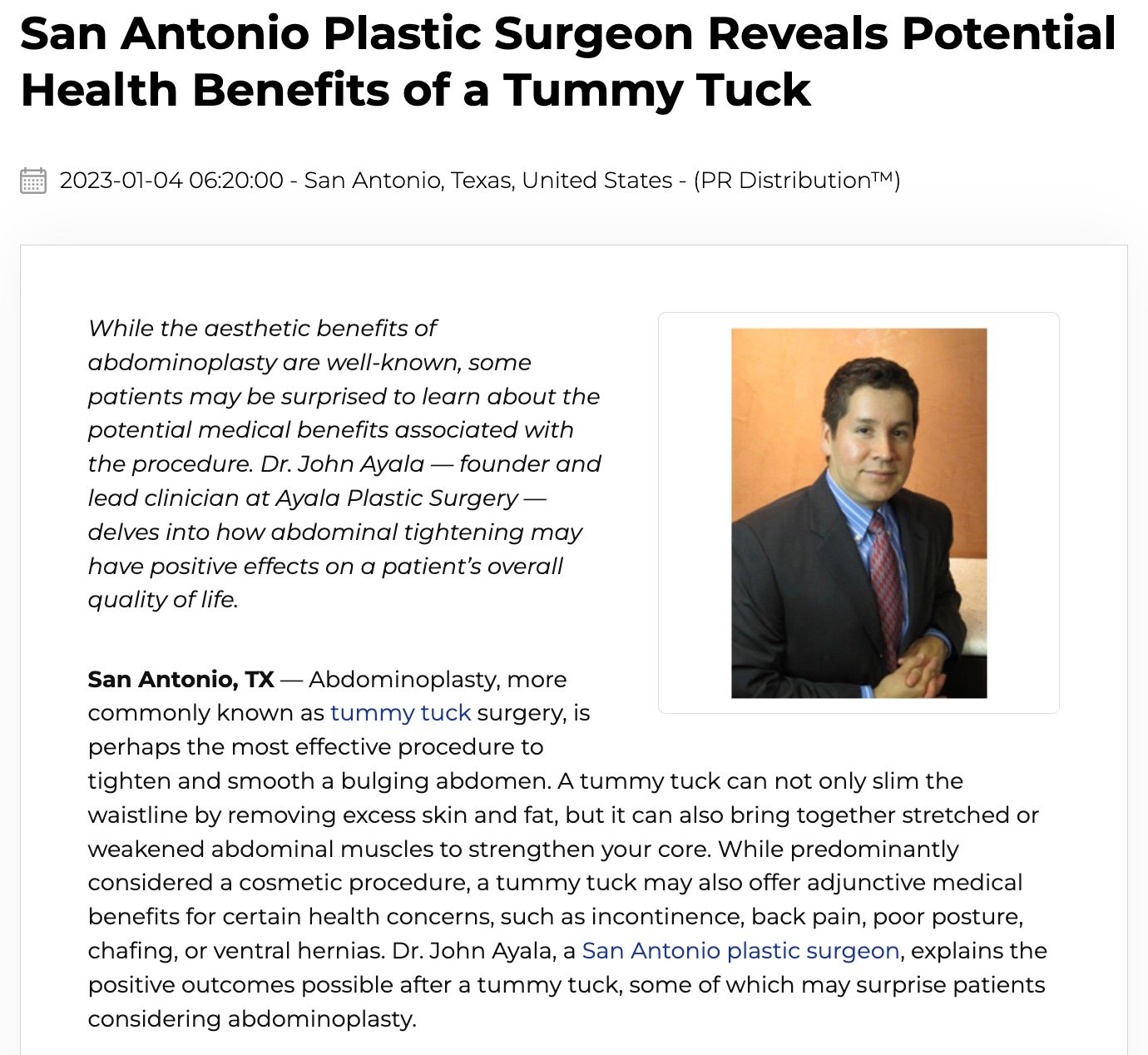
Ayala Plastic Surgery sat down with board-certified plastic surgeon Dr. John Ayala, MD, FACS, to talk through a question that comes up more than patients expect: can a tummy tuck actually offer more than a cosmetic result? Here's what he had to say.
Q: Most people think of a tummy tuck as a purely cosmetic procedure. Is that the full picture?
Not entirely. Abdominoplasty is predominantly considered a cosmetic procedure, and that's the right framing for most patients - but it can also offer genuine adjunctive medical benefits for certain health concerns, depending on what's actually happening in a patient's abdominal wall. The cosmetic outcome and the functional outcome aren't always separate things; they're often two sides of the same underlying repair.
Q: You've built your practice around aesthetic surgery specifically. Does that background change how you approach a question like this, versus a general surgeon might?
I think it does, honestly. A general surgeon evaluating a hernia or muscle separation is typically focused on the functional repair alone - get the tissue closed, resolve the medical issue, done. My training and daily practice are built around understanding both the functional anatomy and the aesthetic outcome simultaneously, which means I'm constantly thinking about how a repair affects both dimensions at once. That's part of why I can speak to something like posture improvement with some confidence - I'm evaluating core structural integrity as a routine part of nearly every abdominoplasty I perform, not just when a patient specifically raises a functional complaint.
Q: What's actually being repaired that could have a medical benefit beyond appearance?
The core of a tummy tuck, beyond skin removal, is repairing separated or weakened abdominal muscles - specifically diastasis recti, where the vertical muscle bands along the midline have pulled apart, most commonly from pregnancy or significant weight fluctuation. That muscle separation isn't just a cosmetic bulge. It represents a genuine loss of core structural support, and that loss of support is what connects to some of the functional benefits patients don't always expect.
Q: You've mentioned posture as one of those benefits. How does that connection work?
When the abdominal core muscles are separated and weakened, the body often compensates with posture changes - a forward-leaning stance, increased curvature in the lower back - to manage the loss of core support. Repairing that muscle separation restores structural integrity to the core, and patients frequently notice their posture improving somewhat naturally afterward, simply because the muscular support that posture depends on has been restored.
Q: What about back pain specifically?
Similar mechanism. A weakened core changes how load gets distributed through the spine during everyday movement, and that altered mechanics can contribute to chronic lower back discomfort in some patients. Tightening and repairing the abdominal muscles doesn't guarantee back pain relief - it's not a treatment for back pain in the way physical therapy is - but for patients whose discomfort is connected to genuine core weakness from muscle separation, the repair can meaningfully change how the spine is supported day to day.
Q: You mentioned incontinence earlier. That surprises a lot of people.
It surprises a lot of patients too. The connection is again about core support - weakened abdominal muscles are part of a broader support system that includes the pelvic floor, and some patients report improvement in mild stress incontinence symptoms following abdominal muscle repair. I want to be careful here: a tummy tuck is not a treatment for incontinence, and patients with significant pelvic floor concerns need a urogynecologic evaluation, not abdominoplasty. But for some patients, the two systems are connected enough that repair of one provides some benefit to the other.
Q: Does the degree of diastasis recti affect how much benefit a patient might see functionally?
Generally, yes, and this is part of why I don't give a single blanket answer to "will I get these benefits" during consultations. A patient with mild, moderate separation is a genuinely different case from a patient with severe, longstanding separation that's been present for years - the degree of structural compromise differs, and so does the degree of restoration a repair can realistically provide. I evaluate this individually for every patient during the physical exam, which is really the only reliable way to have this conversation. Reading about someone else's outcome online, positive or negative, isn't a substitute for an exam of your own specific anatomy.
Q: What about hernias?
This is one of the more direct medical connections. Ventral hernias - where abdominal tissue pushes through a weakness in the muscle wall, often at or near the same midline area affected by diastasis recti - can sometimes be addressed as part of the same surgical repair used in a tummy tuck. This isn't automatic or universal; it depends entirely on the specific hernia and a patient's individual anatomy, and it requires careful surgical planning. But for patients who have both a hernia and cosmetic concerns in the same anatomical area, there can be a real efficiency in addressing both in one coordinated procedure rather than two separate surgeries.
Q: You also mentioned chafing.
That one's more straightforward than the others - it's about the mechanics of excess, overhanging skin rather than muscle repair specifically. Skin folds that persist after significant weight loss or pregnancy can cause chronic friction, irritation, and sometimes skin breakdown in the folds themselves. Removing that excess skin directly resolves the mechanical cause of the chafing, which is a genuinely medical benefit even though it stems from the same skin-removal component that produces the cosmetic result patients are usually picturing.
Q: Should someone pursue a tummy tuck specifically for these medical benefits, rather than for cosmetic reasons?
I'd frame it carefully. A tummy tuck remains, first and foremost, a cosmetic procedure from an insurance and classification standpoint, and it isn't the appropriate first-line treatment for back pain, incontinence, or posture problems on their own - those deserve their own dedicated medical evaluation and treatment first. What I'd say instead is this: for patients who are already considering a tummy tuck for cosmetic reasons and happen to have diastasis recti, mild stress incontinence, posture changes, or a qualifying hernia, it's worth having an honest conversation about whether those functional concerns are also connected to the same underlying muscle separation the surgery addresses. Sometimes they are, and that's a meaningful bonus to an already-planned procedure - not a reason to pursue major surgery for a symptom that has its own, more targeted treatment path.
Q: How would a patient even know if their symptoms are connected to diastasis recti versus something else entirely?
That's exactly what a proper physical exam is for, and it's not something I'd expect a patient to self-diagnose accurately from research alone. Diastasis recti has a fairly specific physical presentation - a visible or palpable gap along the vertical midline of the abdomen, often more noticeable when the patient engages their core, sometimes with a distinct bulging or doming pattern. During a consultation, I'll physically assess for that separation directly, alongside reviewing the patient's broader symptom history. If what a patient is experiencing doesn't match that pattern, I'll say so directly rather than attributing symptoms to the abdominal wall simply because that's the consultation they came in for. Plenty of back pain and posture issues have nothing to do with abdominal muscle separation, and it would be a disservice to imply otherwise just to build a case for surgery.
Q: For patients who are on the fence, what would you say to help them decide whether it's worth bringing up these functional symptoms during a cosmetic consultation?
Bring it up regardless of whether you think it's relevant - let me be the one to decide whether it connects to your abdominal wall or not. I'd rather hear about a symptom that turns out to be unrelated than have a patient stay quiet about something that actually does tie into the repair I'm already planning. It costs you nothing to mention it, and it occasionally changes how I approach the surgical plan in ways that genuinely benefit the patient beyond the cosmetic result alone.
Q: Is there research supporting these functional benefits, or is this mostly anecdotal from your own practice?
It's a mix, and I want to be transparent about that distinction. The muscle-repair mechanism itself - physically reconnecting separated rectus abdominis muscles - is well-documented surgical technique, and the biomechanical logic connecting core support to posture and spinal load is sound and widely understood. The specific functional outcomes, like improvement in mild stress incontinence or chronic back pain, are supported by a combination of published case reports and consistent patterns I've observed across my own patients over years of practice, though I'd stop short of calling any of this a guaranteed, universally proven outcome the way I would for the core cosmetic result of the procedure itself. That's exactly why I frame these as "potential" benefits rather than promised ones.
Q: Any final thoughts for patients weighing this?
Come in with your full picture - not just your aesthetic goals, but anything else going on with your core, your back, or your skin in that area. A thorough consultation looks at all of it together, and that's the best way to understand whether your specific case might see some of these additional benefits alongside the cosmetic outcome most patients are there for in the first place.
Patients interested in learning more about tummy tuck surgery at Ayala Plastic Surgery, including candidacy for combined hernia repair or diastasis recti correction, are encouraged to schedule a consultation with Dr. Ayala.
Frequently Asked Questions
Can a tummy tuck actually improve back pain?
It can for some patients whose back pain is connected to core weakness from diastasis recti, since muscle repair restores structural support that affects spinal load distribution. It isn't a guaranteed treatment for back pain and shouldn't replace other back pain evaluation.
Does a tummy tuck help with incontinence?
Some patients report improvement in mild stress incontinence symptoms following abdominal muscle repair, due to the connected support systems between the core and pelvic floor. It isn't a treatment for incontinence, and significant symptoms warrant a separate urogynecologic evaluation.
Can a hernia be repaired during a tummy tuck?
Sometimes, depending on the specific hernia and its location relative to the muscle repair already involved in abdominoplasty. This requires individualized surgical planning and isn't appropriate for every hernia.
Why does a tummy tuck sometimes improve posture?
Repairing separated abdominal muscles restores core structural support, which can allow the body to move away from compensatory postural patterns - like forward-leaning stance - that developed to manage the loss of that support.
Should I get a tummy tuck specifically for these medical benefits?
Generally no - a tummy tuck remains primarily a cosmetic procedure, and functional concerns like back pain or incontinence deserve their own dedicated medical evaluation first. These benefits are best understood as a possible bonus for patients already considering the procedure for cosmetic reasons.